Leadership styles explained: which type of leader are you?

What kind of leader are you when the pressure is on? Explore seven common leadership styles, discover the strengths and blind spots of each and take a quick quiz to uncover your natural approach.
Think about the last time your team hit a wall.
Did you gather everyone together to figure it out? Step in with a clear plan and take the wheel? Or focus on the person struggling, asking questions and coaching them through it?
Chances are, you've done all three. Just not always at the right moment.
Most of us have a default leadership style: an instinctive way of showing up when things get difficult. Understanding yours can help you recognise what you naturally do well, where your blind spots might sit and when the situation needs something different from you.
So before we get into the theory, let's start with you.
Leadership style is not a fixed personality type. Most leaders draw on different approaches depending on the team, task and situation.
Your default leadership style can reveal both your natural strengths and your blind spots.
Effective leadership is less about choosing the "best" style and more about recognising when your usual approach fits and when you need to adapt.
A quick leadership style quiz can help you spot patterns in how you make decisions, motivate others and respond under pressure.
Developing as a leader often means expanding your range, not replacing your instincts.
Structured postgraduate study — particularly an online MBA — can help working professionals broaden their leadership capability across real business contexts.
What is a leadership style?
A leadership style is the way you tend to make decisions, communicate expectations, motivate people and guide a team towards shared goals.
It isn't a fixed personality type. Your approach can change depending on who you're leading, how experienced your team is, how much time you have and what's at stake. You might be collaborative when shaping a strategy, directive when something goes wrong and coaching-focused when someone is ready to grow.
The question isn't whether you fit neatly into one leadership style. It's which style you reach for first, and whether it's what the moment actually needs.
What's your leadership style? Take the two-minute quiz
Your leadership instincts often show up most clearly under pressure, before you've had time to second-guess them.\
For each scenario, choose the response that feels most natural to you. Don't choose the answer you think a "good leader" should give. Go with what you'd actually be most likely to do.
This isn't a validated psychological assessment. Think of it as a quick mirror for spotting patterns in how you lead.
Scenario 1: Your team has just been handed a challenging new objective
What do you do first?
A. Explain the bigger picture and why the objective matters. (Transformational)
B. Bring everyone together and ask how they think you should approach it. (Democratic)
C. Establish responsibilities, deadlines and clear expectations. (Directive/transactional)
D. Ask people what support they need from you to succeed. (Coaching/servant)
Scenario 2: One of your strongest team members wants more responsibility
What feels most natural?
A. Give them a stretch project, agree on the outcome and let them run with it. (Delegative)
B. Meet with them regularly, ask questions and coach them through the challenges. (Coaching)
C. Create clear development goals, milestones and measures of progress. (Transactional)
D. Ask where they want to grow and work together on what the next step could look like. (Servant/democratic)
Scenario 3: A major decision needs to be made quickly
What do you do?
A. Get the key people together for a quick sense-check before deciding. (Democratic)
B. Make the call, give the team clear direction and explain your reasoning. (Directive)
C. Give the decision to the person closest to the issue and trust their judgement. (Delegative)
D. Reconnect everyone to the outcome you're working towards, then make the decision that best supports it. (Transformational)
Scenario 4: Your organisation is going through significant change
Where does your attention go first?
A. Helping people understand where you're heading and why the change matters. (Transformational)
B. Supporting people individually as they adjust to what's changing. (Coaching/servant)
C. Creating clarity around new responsibilities, expectations and ways of working. (Directive/transactional)
D. Involving the team in working out how the change should happen in practice. (Democratic)
Scenario 5: Team performance has started to slip
What's your instinct?
A. Reset the standards, measures and expectations everyone is working towards. (Transactional/directive)
B. Sit down with people to understand what's getting in the way. (Coaching)
C. Ask the team collectively what isn't working and what needs to change. (Democratic/servant)
D. Give capable people greater ownership over solving the problem. (Delegative)

What do your answers say about you?
Look at the leadership styles attached to the answers you chose. If one or two kept appearing, they may be your natural defaults.
| If you leaned towards… | Your instinct may be to… | Your growth edge may be… |
| Transformational | Create vision and momentum | Turning the big picture into clear execution |
| Democratic | Bring people into decisions | Knowing when consultation needs to stop |
| Directive | Create clarity and act quickly | Making enough room for challenge and input |
| Coaching | Develop people through support and questions | Knowing when someone needs direction, not another question |
| Servant | Remove barriers and enable others | Balancing support with authority and accountability |
| Transactional | Create structure and measurable expectations | Staying open to experimentation and new approaches |
| Delegative | Trust capable people with autonomy | Staying connected enough to provide direction when needed |
A mixed result isn't a bad one. In fact, it may simply mean you already shift your approach depending on the situation.
The interesting question is not "Which label am I?"
It's "What do I default to, and what happens when that approach isn't what my team needs?"
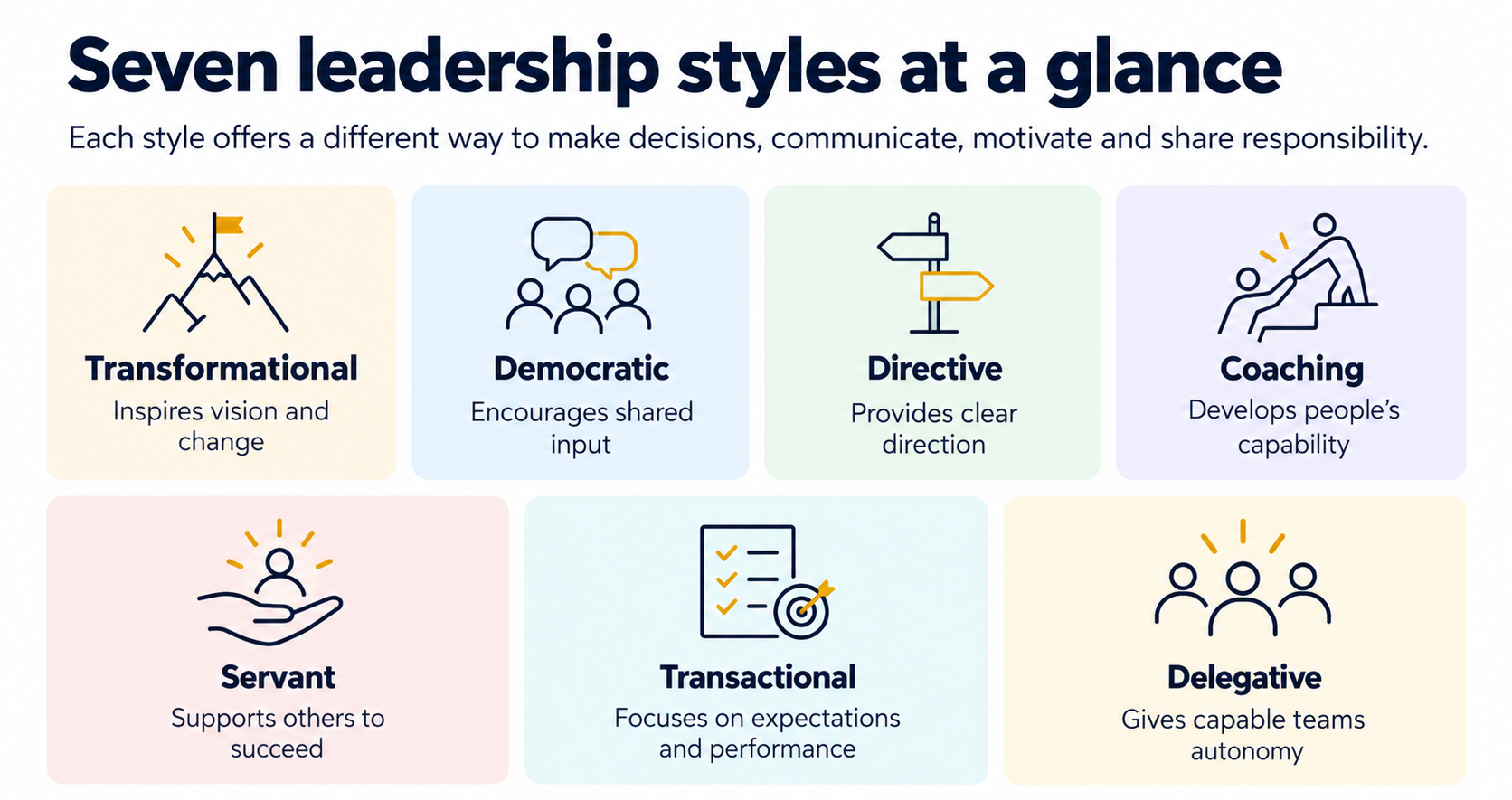
The seven leadership styles in practice
1. Transformational leadership
Transformational leaders naturally look towards what could be different. They create direction, connect everyday work to a bigger purpose and help people see possibility in change.
You might recognise yourself if: a restructure is announced and your first instinct is to help the team understand where it could lead, rather than simply working through the new org chart.
Your strength: creating momentum and helping people connect their work to something bigger.
Your blind spot: sometimes the vision gets there before the execution does. Your team may understand why everything is changing but still be wondering what they need to do on Monday.
Stretch yourself: translate the vision into priorities, responsibilities and decisions people can act on.
2. Democratic leadership
Democratic leaders want the best thinking in the room, not necessarily their own idea to win. They invite different perspectives, ask questions and involve people in decisions that affect them.
You might recognise yourself if: a process needs fixing and your immediate reaction is to bring operations, finance, marketing and anyone else affected into the same room before deciding what happens next.
Your strength: creating stronger ownership and drawing on expertise you don't personally have.
Your blind spot: not every decision benefits from another meeting. Consultation can become a way of delaying a difficult call.
Stretch yourself: be clear about when you're asking for input and when you're asking the team to make the decision with you.
3. Directive leadership
Directive leaders are comfortable stepping forward when clarity is needed. They make decisions, set expectations and tell people what needs to happen next. That can sound unfashionable in a world that celebrates collaboration, but there are situations where it is exactly what effective leadership requires.
You might recognise yourself if: something goes wrong operationally and you immediately assess the problem, assign responsibilities and get everyone moving.
Your strength: creating certainty when the environment is uncertain.
Your blind spot: if every problem becomes a moment for you to take control, people can stop offering ideas or challenging your assumptions.
Stretch yourself: once the urgent moment has passed, deliberately reopen the conversation. Ask what the team saw that you didn't.
4. Coaching leadership
Coaching leaders are interested in what someone could become, not simply what they can deliver today. Instead of immediately providing the answer, they ask questions, give feedback and create opportunities for people to work things out themselves.
You might recognise yourself if: a technically brilliant employee steps into management and your instinct is to help them think through difficult conversations rather than scripting those conversations for them.
Your strength: developing capability that continues to grow after the conversation ends.
Your blind spot: sometimes people genuinely need an answer. Coaching every problem can become frustrating when the situation requires clarity.
Stretch yourself: ask yourself — does this person need development right now, or do they simply need direction?
5. Servant leadership
Servant leaders start with a deceptively simple question: what does my team need from me to do its best work? That can mean listening, clearing obstacles, advocating for resources or stepping aside when someone else is better placed to lead.
You might recognise yourself if: your team is stretched and, instead of pushing harder, you start looking for the bottleneck making their jobs unnecessarily difficult.
Your strength: building trust and creating an environment where people feel supported to perform.
Your blind spot: support without clear expectations can make accountability harder to see.
Stretch yourself: make sure helping people succeed doesn't mean avoiding the conversations they need to hear.
6. Transactional leadership
Transactional leaders like clarity. What are we trying to achieve? Who owns what? How will we know whether we succeeded? They create structure through expectations, measures, feedback and accountability.
You might recognise yourself if: your team has defined targets and you instinctively build clear milestones, regular check-ins and agreed measures around them.
Your strength: people know where they stand and what is expected.
Your blind spot: not every problem can be solved with a clearer KPI. Over-reliance on structure can leave little room for experimentation.
Stretch yourself: when performance stalls, resist immediately tightening the measures. Ask whether the system itself needs to change.
7. Delegative leadership
Delegative leaders are comfortable handing over control when someone else has the expertise to own it. Done well, this isn't disappearing. It's setting the destination, agreeing on boundaries and trusting capable people to determine how they get there.
You might recognise yourself if: you're leading experienced specialists and know that telling them exactly how to do their jobs would add little beyond frustration.
Your strength: creating ownership and giving expertise room to work.
Your blind spot: autonomy can start to feel like abandonment if expectations, feedback or priorities become unclear.
Stretch yourself: delegate the how, not the connection. Stay close enough that people know what matters and when they should bring you back in.
Why does your leadership style matter?

Because the way you lead becomes part of the environment everyone else works in.
Gallup research finds that managers account for around 70% of the variance in team engagement, highlighting the influence day-to-day leadership can have on how people experience work.
But that doesn’t mean there’s one leadership style everyone should copy.
A democratic leader can build genuine ownership and still frustrate a team by consulting endlessly. A directive leader can bring exactly the clarity a crisis needs, but become exhausting if every routine decision is treated with the same urgency. A delegative leader can give experienced specialists the autonomy to thrive, or leave a developing employee wondering whether anyone is actually leading them.
Is there a best leadership style?
No. What works brilliantly with one team, task or moment can fall flat in another.
That’s the principle behind situational leadership, developed by Paul Hersey and Kenneth Blanchard: effective leadership depends on adapting your approach to the people you’re leading and the demands of the situation.
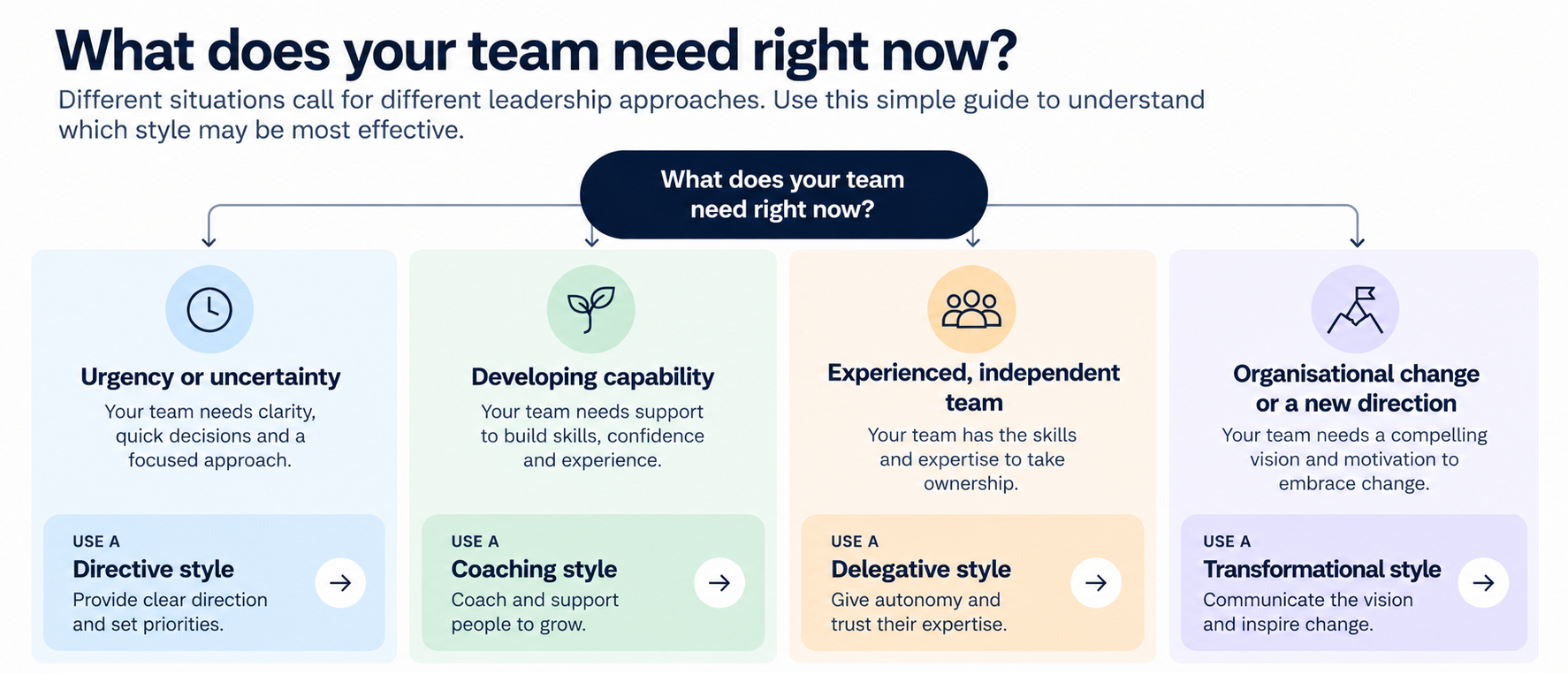
In practice, that could mean consulting when specialist expertise will improve the decision, stepping in with clear direction when time is short, coaching someone who is developing, or giving greater autonomy to a team that has already proven its capability.
Imagine an experienced group of specialists developing a new product. Giving them room to make decisions and draw on their expertise may produce the strongest result. An hour later, a serious operational issue emerges and an immediate response is needed. Suddenly, consultation matters less than clarity and decisive action.
Same leader. Same day. Different gear.
That ability to shift matters more than fitting neatly into one category. Research on leadership adaptability reinforces the value of responding to changing conditions rather than relying on a single preferred approach.
So the more useful question isn’t simply:
What kind of leader am I?
It’s:
What kind of leadership does this situation need from me?
Can you have more than one leadership style?
Absolutely.
Leadership styles aren’t fixed personality types. Your behaviour can evolve with experience, feedback and deliberate practice, and most leaders draw on more than one approach.
You might naturally be more directive early in your career when you’re focused on establishing credibility and delivering results. As your responsibilities grow, you may become more comfortable delegating, coaching others or bringing different voices into decisions.
The goal isn’t to replace your natural style. It’s to understand it well enough that you can recognise when another approach might work better.
How can you develop your leadership style?
Start by noticing your defaults.
Pay attention to what happens when pressure rises. Do you take control? Ask for more opinions? Retreat to the numbers? Start solving everyone else’s problems? Step back and let the team work it out?
Then ask for feedback. The people you lead may experience your leadership differently from the way you intend it.
From there, deliberately practise the approaches that feel less natural. If you usually direct, try coaching. If you tend to consult, practise making the call when a decision is yours to make. If you instinctively delegate, spend more time setting context and expectations before stepping away.
The aim isn’t to lose what already works for you.
It’s to add more gears.
Where could you stretch your leadership range?
As your responsibilities grow, leadership often becomes less straightforward. You’re dealing with more stakeholders, competing priorities, greater uncertainty and decisions that cut across areas you may not have worked in before.
That’s where structured postgraduate study can help broaden your range. Not because an MBA gives you a new personality, but because it exposes you to business problems that require different kinds of judgement and asks you to work across disciplines beyond your existing expertise.
The UTS Online Master of Business Administration builds capability across leadership, strategy, finance, marketing, economics, data, sustainability and decision-making. You can then shape part of your studies through electives spanning Technology Management, Strategic Communication, Sustainable Leadership, Education, Health and International Relations.
Where you choose to stretch could depend on the leadership instincts you already bring.
If you’re a transformational leader: you may be energised by change and motivated to help others see what’s possible. Leading People and Change develops your understanding of how people and organisations navigate transformation, while Technology Management electives can broaden how you think about disruption, innovation and organisational agility.
If you lean democratic: you’re likely comfortable drawing in different perspectives and building support around a decision. Strategy and Negotiation can challenge you to navigate situations where priorities compete and consensus isn’t always possible, while Strategic Communication electives can strengthen how you engage and influence different stakeholder groups.
If you’re a coaching or servant leader: developing people and removing barriers may already come naturally. Leading People and Change connects directly to the people side of leadership, while Education (Learning and Leadership) electives can broaden how you think about capability, learning and development across an organisation.
If you’re more directive or transactional: evidence, clarity and structure may be among your strengths. Subjects such as Data-Driven Decision-Making, Accounting for Decision Makers and Financial Fundamentals can build on those instincts, while electives in areas such as Sustainable Leadership or Strategic Communication can stretch how you weigh competing priorities, perspectives and longer-term impacts.
Ultimately, that’s the value of understanding your leadership style.
Your strengths show you where you naturally lead. Your blind spots show you where there’s room to grow.
Frequently asked questions
Start with your behaviour, particularly when things become difficult. Think about your last few high-pressure decisions: did you ask for input, take control, focus on the individual, return to the data or hand ownership to someone else? The quiz above can help surface those tendencies, while honest feedback from colleagues and people you lead can reveal patterns you may not notice yourself.
Yes. Leadership behaviour can change through experience, feedback and deliberate practice. As your responsibilities grow, you may also find that approaches that worked earlier in your career are less effective with different teams or more complex decisions. The goal isn't to abandon your default style — it's to expand the range of approaches you can draw on.
There is no single leadership style that works best in every situation. Different teams, tasks and levels of urgency call for different approaches. Effective leadership is less about choosing one style and more about recognising when your usual approach fits the situation and when you need to adapt.
They overlap, but they are not quite the same thing. Management generally focuses on organising work: setting goals, allocating resources, tracking progress and making sure things get delivered. Leadership style is more about how you influence, motivate, communicate with and guide the people doing that work. Senior roles usually require both.
Leadership style matters because it shapes how teams communicate, perform and respond to challenges. The way a leader sets direction, gives feedback and makes decisions has a direct influence on engagement, accountability and how effectively a team functions day to day.
Your leadership style is a starting point, not a verdict
If the quiz gave you a clear result, useful.
If your answers were all over the place, also useful.
Leadership is rarely about fitting one neat description. The bigger opportunity is understanding your instincts well enough to recognise when they are helping and when you need to respond differently.
Because knowing your default leadership style is useful.
Knowing when to move beyond it is leadership.
