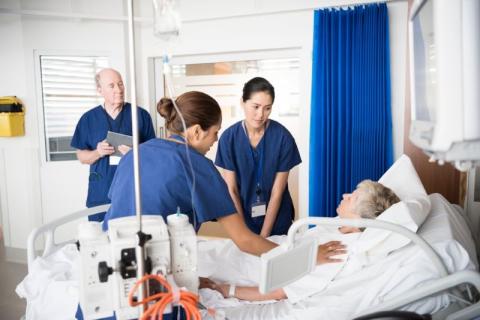
Nurses are shaping what healthcare becomes next

Nurses are often the first to notice when something changes.
A subtle shift in a patient’s breathing. A pattern in the observations that others have missed. A family that needs more support before discharge. A team that needs clear direction in a high-pressure moment.
That ability to assess, respond and lead is becoming more important as healthcare grows rapidly more complex. Patients are presenting with more diverse needs. Clinical environments are moving faster, and teams are working under increasing pressure. Across the system, nurses are being called on to do more than deliver care. They are helping shape it.
For experienced registered nurses, advanced nursing is not always about moving away from the bedside. It can be about deepening clinical judgement, strengthening leadership capability and building the confidence to influence outcomes in the moments that matter most.
The future of healthcare needs advanced nurses. We need clinicians who see the whole picture, act early, lead calmly and improve care directly at the point of delivery.
Healthcare is becoming more complex
In dynamic care environments, experience matters. But experience alone is not always enough.
The reality of modern nursing is that the baseline of patient care has shifted. In 2024, the five disease groups causing the most health burden in Australia were cancer, mental health conditions and substance use disorders, musculoskeletal conditions, cardiovascular diseases and neurological conditions. Together, these accounted for around 64% of total disease burden, reflecting the growing impact of chronic and long-lasting conditions across the country.
Australia’s ageing population adds another layer of complexity. The proportion of Australians aged 65 and over increased from 4.6% in 1922 to 16.2% in 2021, and is projected to reach around 20.7% by 2066. As patients increasingly present with multiple and interconnected health needs, nurses are often the ones coordinating care, noticing changes early and helping teams respond safely.
This complexity is reshaping the workforce. Health Care and Social Assistance is now Australia’s largest employing industry, with around 2.4 million workers and 16.3% of workers having their main job in the sector. Yet despite this scale, the system remains under pressure. Resource constraints, rapid policy reforms and increasing patient acuity mean nurses are carrying more responsibility across care settings.
National workforce modelling from the Draft National Nursing Workforce Strategy projects an undersupply of 70,707 full-time equivalent nurses by 2035, with around 79,473 nurses needed to fill the gap if supply does not keep pace with demand.
In this environment, nurses need a different level of capability. They are not just working within healthcare systems. They play a critical role in keeping care connected, responsive and safe. When a patient with acute cardiovascular and respiratory comorbidities deteriorates, the responding nurse needs more than procedural knowledge. They need advanced pathophysiology, sharp clinical reasoning and the ability to coordinate a multidisciplinary response in real time.
Healthcare is changing. Advanced nursing capability has never mattered more.

Advanced nursing is about more than seniority
There is a common misconception in healthcare that advanced nursing simply means having more years of experience. This is not the case. Advanced nursing is not just about how long you have been practicing. It is about how you think, lead, assess and respond.
The Nursing and Midwifery Board of Australia outlines that advanced practice involves incorporating professional leadership, education and research into clinical care. It requires higher-level clinical reasoning and complex decision-making.
An advanced nurse operates with a different mindset. They do not just complete tasks. They evaluate the rationale behind the care plan. They anticipate complications before they occur.
This advanced capability spans several key areas:
- Clinical judgement and diagnostic reasoning
- Applying the latest evidence-based practice
- Comprehensive physical assessment
- Interdisciplinary communication
- Systems thinking and risk mitigation
- Quality and safety improvement
Developing these skills takes intentional study and practice. It requires stepping back from the daily routine to examine the broader mechanisms of health and disease. It means learning how to interpret complex patient data and translate it into clear, actionable care plans.
When a nurse makes this shift, their impact expands. They become a resource for their peers, a trusted voice for their patients and a catalyst for better clinical outcomes.
Clinical leadership in nursing starts at the bedside
A lot of nurses want career progression but fear that leadership means stepping away from patients. They worry that advancing their career will inevitably force them into an office, separated from the clinical environment they are passionate about.
We need to reframe how we view clinical leadership. Some of the most important leadership in healthcare does not happen in boardrooms. It happens in handovers, rapid responses, ward conversations and moments where a nurse has the confidence to speak up.
The bedside is a place of profound leadership. When a patient’s condition changes rapidly, the nurse in the room dictates the tone of the response. A calm, decisive and knowledgeable nurse anchors the entire team. They delegate effectively, communicate critical information to medical staff and ensure the patient remains the central focus of the intervention.
This form of leadership is vital for patient safety. It is the nurse who challenges a medication order that does not align with the patient’s renal function. It is the nurse who notices that a standard protocol is not working for a specific demographic and advocates for a personalised approach.
Advanced nurses use their deep clinical knowledge to empower others. They mentor junior staff not through formal lectures but through real-time guidance during complex procedures. They foster a culture of teaching and learning directly on the floor.
Leadership in nursing is about influence. By building advanced capabilities, nurses can exert a powerful influence over patient outcomes, team morale and ward culture without ever needing to leave the bedside.
How specialisation strengthens advanced nursing practice
Specialisation helps nurses build deeper capability in the environments where advanced judgement matters most. By focusing on a specific area of practice, nurses can move from highly capable generalists to clinicians with deeper expertise, stronger confidence and greater influence in their field.
In acute and critical care settings, advanced capability can change the way nurses assess risk, recognise deterioration and respond under pressure. In these environments, the margin for error can be narrow. A patient’s trajectory can alter in minutes, and nurses often need to interpret information quickly, escalate concerns and support coordinated clinical decisions.
The need for advanced capability is especially clear in acute care.
National projections show an expected undersupply of 26,665 full-time equivalent nurses in the acute care sector by 2035.
As demand increases, nurses with advanced acute care knowledge will play an important role in recognising early signs of deterioration, strengthening medication safety and responding to the pathophysiological processes that drive common acute health problems.
Specialisation provides a framework for this complex clinical reality. It gives nurses the theoretical foundation to question anomalies, suggest alternative interventions and collaborate confidently with specialists. With advanced clinical reasoning, deeper evidence-based knowledge and stronger understanding of their practice area, specialised nurses are better equipped to advocate for patients, influence care decisions and contribute confidently in high-pressure clinical environments.

The future needs nurses who can improve systems of care
Healthcare systems are massive, intricate machines. They are prone to inefficiencies, communication breakdowns and structural errors. Often, the solutions to these systemic issues do not come from top-down management directives. They come from the clinicians who navigate these systems every single day.
Advanced nurses are uniquely positioned to drive service innovation. Because they possess a deep understanding of both clinical care and health systems, they can identify exactly where processes fail.
They contribute to better practice by evaluating models of care and proposing evidence-based improvements. They lead quality and safety initiatives that reduce hospital-acquired complications. They streamline patient flow to ensure timely access to appropriate interventions.
This systems-level influence is crucial. As healthcare resources become tighter, the system relies on advanced nurses to ensure care remains safe, equitable and effective. These nurses act as change agents. They introduce contemporary approaches to digital health, implement trauma-informed care frameworks and ensure that vulnerable populations receive culturally safe support.
Nurses are carrying more complexity than ever. It is time their capability matched their incredible impact. By stepping into advanced roles, nurses ensure that the evolution of healthcare remains firmly grounded in person-centred care.
How UTS Online supports advanced nursing capability
As healthcare becomes more complex, nurses need the confidence to assess, lead and respond with greater authority. The UTS Online Master of Advanced Nursing is designed for registered nurses who are ready to build on their experience and strengthen their capability in complex clinical environments.
Through advanced study in clinical practice, leadership, evidence-based care and health systems, students develop the skills to make informed decisions, respond to complex patient needs and contribute to improved outcomes across patients, teams and systems. The course is designed to translate directly into real-world nursing practice, so students can apply what they learn in their current roles as they study.
Recognising that every nursing career is different, UTS Online offers flexible pathways. Nurses can choose to specialise in areas such as Acute Care or Critical Care, building deeper capability in patient assessment, clinical deterioration, complex patient data and advanced therapeutic interventions. Alternatively, students can tailor their studies through a Flexible major, selecting electives that align with their clinical interests, professional goals and the areas of care they want to influence most.
Delivered online and designed for working nurses, the course supports students to keep building their capability while continuing to make an impact in real clinical settings.
UTS is ranked #1 in Australia and #16 globally for Nursing, reflecting the university’s strength in nursing education, research and practice. For registered nurses ready to build advanced capability, this means learning with a university recognised for shaping the future of the profession.
A way to shape what care becomes next
Nurses have always been central to care. As healthcare changes, the role of nurses is rapidly expanding in scope.
The next generation of advanced nurses will not only respond to complexity. They will help lead through it. They will challenge outdated practices, implement innovative solutions and elevate the standard of care across the entire health sector.
For nurses ready to deepen their expertise, strengthen their confidence and have greater impact across patients, teams and systems, advanced nursing is more than just a career step.
It is a way to shape what care becomes next.

Ready to build advanced nursing capability?
Whether you know exactly where you want to specialise or are still deciding what your next step could look like, UTS Online offers a range of postgraduate nursing courses designed for working registered nurses.
You can choose a Master of Advanced Nursing, start with a Graduate Certificate in Advanced Nursing, or explore a focused Graduate Certificate pathway in acute care, critical care or nursing education.
Explore UTS Online’s nursing courses to compare your options and find a pathway that fits your experience, goals and the impact you want to make next.