Why study the Graduate Certificate in Women’s and Children’s Health with UTS Online?
Top 100 University globally1
Australia’s leading young university2
Top 10 in Australia for graduate employability3
5-star rated for student retention4
1QS World University Rankings, 2027 2Times Higher Education Young University Rankings, 2026 3Times Higher Education Graduate Employability Rankings, 2026. 4Good Universities Guide, 2026
Good care starts with understanding what shapes health
Women and children do not experience health in isolation. Gender, culture, geography, socioeconomic circumstances, life stage and the systems around them can all influence access to care, health experiences and outcomes. Seeing those wider factors can change not only how you understand a person’s needs, but how you respond in practice.
The UTS Online Graduate Certificate in Women’s and Children’s Health builds focused capability across contemporary women’s health, children’s health, sexual and reproductive health and the legal and ethical dimensions of care. Designed for working health professionals, the four-subject course helps you bring a broader, more equitable perspective to practice and provides a pathway into the Master of Women’s and Children’s Health when you’re ready to go further.

Who is this course for?
The UTS Online Graduate Certificate in Women’s and Children’s Health is designed for health professionals who want to deepen their understanding of the distinct health needs and experiences of women, children and families.
Whether you work in nursing, midwifery, public health or an eligible allied health profession, the course can help you bring a stronger women’s and children’s health perspective to your existing practice.
This course may suit professionals looking to:
- Deepen their understanding of women’s and children’s health
- Strengthen knowledge of sexual and reproductive health and rights
- Better understand how gender, culture and social circumstances influence health
- Build more person-centred and culturally responsive approaches to care
- Create a pathway into the Master of Women’s and Children’s Health
See entry requirements under course information for more eligibility information.
What you will study
The UTS Online Graduate Certificate in Women’s and Children’s Health comprises four online subjects totalling 24 credit points, building focused capability across women’s health, children’s health, sexual and reproductive health and the legal and ethical dimensions of care.
Complete all four subjects:
- Contemporary Women’s Health Issues (6CP)
- The Child in the Contemporary World (6CP)
- Global Perspectives on Sexual and Reproductive Health and Rights (6CP)
- Legal and Ethical Issues in Women’s Health (6CP)
CP = credit points. Subject descriptions and learning outcomes are available via the subject links on this page. Subject availability, sequencing and course structures are subject to change.

Flexible course options
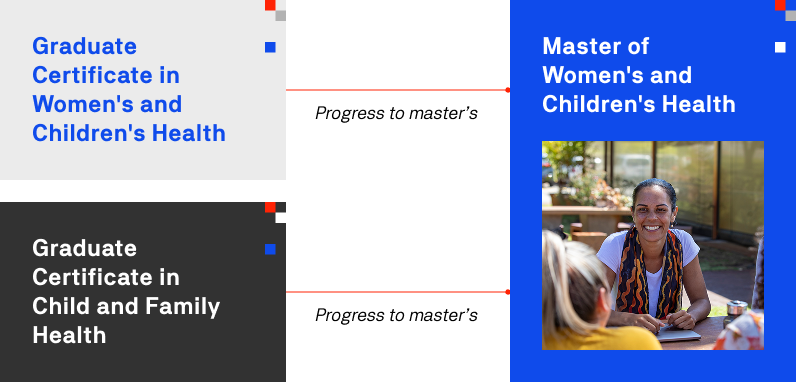
Whether you’re ready to take the next step or prefer to start with a shorter qualification, begin with the Graduate Certificate in Women's and Children's Health or Graduate Certificate in Child and Family Health and continue into the Master of Women’s and Children’s Health when you’re ready.
Learning outcomes
The UTS Online Graduate Certificate in Women’s and Children’s Health gives you the foundation to understand complex health experiences, respond to diverse needs and contribute to more equitable and person-centred care for women, children and families.
Establish a philosophy and practice that puts women and children at the heart of health
Reflect on politics, gender, history and tradition to establish a philosophy and practice designed to meet the individual needs of each woman. Build an ability to recognise the influence of gender, how it intersects with other dimensions of diversity, and the impact on equitable access to services and personal wellbeing.
Learn how to reflect on current practice, policy and research in women’s and children’s health
Critique the legal and ethical issues in women’s health, specifically pertaining to reproduction and birth, through case studies, and reframe these to a woman-centred philosophy. Explore the sociocultural and environmental impacts on children over the past two decades to understand how the unique challenges faced by children impact their health and wellbeing.
Reflect on cultural contexts to provide individualised care
Women of all cultures have individual needs, and not all are afforded the same quality of healthcare. In this course you’ll gain an understanding of the diverse needs and expectations of Indigenous Australian women and women from diverse cultural contexts. Learn to critically reflect on these contexts to inform your professional cultural capability to provide individualised and equitable care.
Gain the foundations of contemporary, strengths-focused leadership
Build the strength, confidence and vision to drive change in women’s and children’s health. Model evidence-based practice and respectful care in your practice. Develop the foundational skills to move into a leadership role including effective communication for various healthcare needs, collaboration and responsiveness in healthcare settings.
Career outcomes
The UTS Online Graduate Certificate in Women’s and Children’s Health builds capability relevant across clinical care, community health, health promotion, policy and service improvement.
Depending on your professional background, registration and experience, graduates may explore opportunities such as:
- Registered Nurse working in women’s or children’s health
- Health Promotion Officer
- Community Health Worker
- Policy & Project Officer
- Women’s and Children’s Health Project Officer
- Health Policy Advisor
- Midwifery or Nursing Educator
- Nursing Manager
- Women's and Children's Health Research Officer
- Health Service Improvement Officer
Career opportunities and role titles vary by professional background, registration and state or territory requirements. Nurses, midwives and allied health professionals may also use the course to deepen or specialise their practice within their existing profession.

Course information
Applicants must have one of the following:
- Completed Australian bachelor's degree or higher qualification, or overseas equivalent, in Nursing/Midwifery, Public Health, Rehabilitation Therapies, or Other Health
OR
- A minimum of 2 years full-time, or equivalent part-time, relevant professional work experience within the past 5 years in an Allied Health Profession, such as social workers, public health practitioners, occupational health therapists, psychologies, physiotherapists, speech pathologists, dietitians, or nutritionists
Supporting documentation to be submitted with the application
For applicants who need to demonstrate professional work experience:
- Curriculum Vitae
- Evidence of current professional registration (where applicable), such as registration with the Nursing and Midwifery Board of Australia (NMBA) or the relevant professional body in the applicant’s home country
Eligibility for admission does not guarantee offer of a place.
Want to check your eligibility?
Not only do we have the right tools and support teams to help you – we have people who care about your success.

$115,000 average salary
Midwives in NSW can earn up to $115,000 per year, reflecting strong demand for skilled professionals in women’s and children’s health..
(Seek)
14% projected job growth for midwives
Midwife roles in Australia are projected to grow by 14% over the next five years, reflecting increasing demand across women’s and children’s health.
(Seek)
15%
of Australia's workforce in health care and social assistance
Health Care and Social Assistance employs 15% of Australia’s workforce, highlighting its critical role in the national employment landscape.
(Australian Bureau of Statistics)
Upcoming intakes
UTS Online courses have 6 intakes per year. The diagram below shows all upcoming intakes. Our next intake is highlighted below.
-
Jan
2027 -
Mar
2027 -
May
2027 -
Jul
2027 -
Aug
2027 -
Oct
2027
Meet our faculty
“The Graduate Certificate in Women’s and Children’s Health is designed to introduce students to the concept of gender as a social determinant of health, and how this impacts the social, cultural, professional, and health needs of women and children.
This course aims to develop skills in working with a range of people, systems, and processes within health services and is the first step in developing in-demand skills to drive system-level change that meets the dynamic needs of communities, clinicians, governments and organisations."
Associate Professor Vanessa Scarf
Director of Postgraduate Midwifery Studies
Associate Professor Vanessa Scarf is Midwifery Director, Postgraduate Studies at UTS. A midwifery academic and researcher, her work focuses on maternity care, birthplace decision-making and the experiences of women and families. Her research spans the costs, outcomes and accessibility of different models of maternity care, including international work exploring midwife-led birthing centres and policies that reduce financial barriers to childbirth.

Download a course guide
Download a course guide to explore detailed subject descriptions, entry requirements, pathway options and fee information.

“I thought completing one subject at a time would be much easier for me to juggle with my work. Everything was in one place. The broad coverage of what I studied has been really helpful, because I’m opening my progression up to those new paths.”
Audrey B, UTS Online Graduate

“I continued some friendships from fellow students and also continued the relationship with UTS.”
Ben G, UTS Online Graduate
Frequently asked questions
A Graduate Certificate in Women’s and Children’s Health is a postgraduate qualification focused on the health and wellbeing of women and children across different life stages and healthcare contexts.
The UTS Online Graduate Certificate in Women’s and Children’s Health develops foundational capability across contemporary women’s health, children’s health, sexual and reproductive health, legal and ethical issues, culturally responsive practice and evidence-informed care.
The UTS Online Graduate Certificate in Women’s and Children’s Health is designed for health professionals who want to build specialist knowledge in women’s and children’s health.
It can suit midwives, nurses and allied health professionals such as social workers, public health practitioners, occupational therapists, psychologists, physiotherapists, speech pathologists, dietitians and nutrition professionals.
No. The course is not limited to nurses and midwives.
Eligible allied health professionals can also apply. Current entry pathways include a recognised bachelor’s degree or higher qualification in Nursing, Midwifery, Public Health, Rehabilitation Therapies or another recognised health discipline, or relevant professional experience in an allied health profession.
Yes. A bachelor’s degree is not the only entry pathway.
Current entry requirements allow applicants to be considered with at least two years of full-time, or equivalent part-time, relevant professional work experience within the previous five years in an allied health profession such as social work, public health practice, occupational therapy, psychology, physiotherapy, speech pathology, dietetics or nutrition.
Supporting documentation is required for applicants applying on the basis of professional experience.
You’ll build foundational capability in contemporary women’s and children’s health, sexual and reproductive health, legal and ethical issues, culturally responsive care and evidence-informed practice.
The course also explores how factors such as gender, culture, socioeconomic circumstances, policy and social support can influence health outcomes and access to care for women and children.
The UTS Online Graduate Certificate in Women’s and Children’s Health comprises four core subjects totalling 24 credit points:
• Contemporary Women’s Health Issues
• The Child in the Contemporary World
• Global Perspectives on Sexual and Reproductive Health and Rights
• Legal and Ethical Issues in Women’s Health
Together, these subjects build a focused foundation across women’s health, children’s health, reproductive health and ethical practice.
Yes. Culturally responsive practice is an important part of the course.
You’ll examine how culture, gender, history and other dimensions of diversity influence health experiences and access to care, including the needs and expectations of Indigenous Australian women and women from diverse cultural contexts.
The course is designed to strengthen your ability to reflect on these factors and contribute to more individualised and equitable care.
Yes. The course builds foundational leadership capability alongside specialist women’s and children’s health knowledge.
You’ll develop skills in evidence-informed practice, communication, collaboration and responsiveness in healthcare settings, helping you contribute to improvement and change within your professional scope.
The UTS Online Graduate Certificate in Women’s and Children’s Health can be completed in a minimum of eight months.
The course comprises four online subjects totalling 24 credit points.
Yes. The course is designed for health professionals completing postgraduate study alongside work and personal commitments.
You’ll study online through structured weekly learning and can connect what you learn with contemporary women’s and children’s health challenges.
How you balance work, study and personal commitments will depend on your individual circumstances, so it is important to plan for the weekly requirements of each subject.
Yes. The Graduate Certificate in Women’s and Children’s Health provides a pathway into the UTS Online Master of Women’s and Children’s Health.
The Graduate Certificate comprises four subjects totalling 24 credit points. Current course information states that students who progress to the master’s may have approximately nine additional subjects to complete, although the exact number can vary because some master’s subjects have different credit-point values.
Credit is subject to current UTS course and articulation rules.
The Graduate Certificate in Women’s and Children’s Health is a four-subject postgraduate qualification that provides a focused foundation in women’s health, children’s health, reproductive health and legal and ethical practice.
The Master of Women’s and Children’s Health is a 72-credit-point degree that develops broader and deeper capability across public health, leadership, research and specialist study, with defined majors and a flexible pathway.
The Graduate Certificate can be completed as a standalone qualification or used as a pathway into the master’s.
The Graduate Certificate in Women’s and Children’s Health has a broader focus across women’s health, children’s health, sexual and reproductive health, legal and ethical issues and culturally responsive practice. It is open to eligible nurses, midwives and allied health professionals.
The Graduate Certificate in Child and Family Health is specifically designed for nurses and midwives and focuses on child development, family health and supporting parents and caregivers. It also includes community-based clinical placement experience.
The better fit depends on your professional background and whether you want broader women’s and children’s health capability or a more clinically focused child and family health pathway.
You may be eligible to apply for Recognition of Prior Learning, or RPL, if your previous study or professional experience meets the relevant UTS course requirements.
UTS assesses RPL after an offer of enrolment has been accepted. The amount of credit available depends on your individual circumstances and the evidence provided.
The Graduate Certificate can help health professionals build specialist capability that supports work with women, children and families within their existing professional scope.
Career directions identified by UTS Online include roles such as Child Health Nurse, Community Health Nurse or Midwife in child and family services, Parenting and Family Support Practitioner, GP Practice Nurse and Early Parenting Support Practitioner.
Some roles require specific professional registration or prior clinical qualifications, so career outcomes will depend on your existing background and role requirements.
The course can help you add specialist women’s and children’s health capability to your existing health profession while strengthening evidence-informed practice, communication, culturally responsive care and foundational leadership skills.
Depending on your background, this can support progression towards more specialised practice, education, community health, policy, project or leadership responsibilities.
Whether the course is worthwhile depends on your professional background, career goals and the specialist capability you want to build.
For eligible health professionals who want a shorter postgraduate qualification, it can provide a focused way to deepen knowledge of women’s and children’s health without initially committing to the full master’s degree.
It can also provide a pathway into the UTS Online Master of Women’s and Children’s Health if you decide to continue your studies.
The current indicative tuition fee for the UTS Online Graduate Certificate in Women’s and Children’s Health is $14,340 in total, with an indicative fee of $3,585 per subject.
Fees are indicative and subject to change. Your total course fee may vary depending on your study plan, Recognition of Prior Learning and the fees applicable at the time of enrolment, so refer to the UTS Online fees page for the latest information.
Yes. FEE-HELP is available to eligible students studying the UTS Online Graduate Certificate in Women’s and Children’s Health.
FEE-HELP is an Australian Government loan scheme that can help eligible full-fee-paying students cover some or all of their tuition fees.
Eligibility requirements apply, so check the current FEE-HELP information before enrolling.
UTS Online offers six intakes per year for the Graduate Certificate in Women’s and Children’s Health.
Intake dates can change from year to year, so refer to the course page for the next available intake and current application dates.
For a standard six-credit-point UTS Online subject, you should typically allow around 15–20 hours per week for study.
This can include working through weekly learning materials, completing readings and activities, participating in online discussions and preparing assessments. Your actual study time may vary depending on the subject, your previous experience and assessment deadlines.
UTS Online students generally study one subject at a time, helping you focus your study around your professional and personal commitments.
For more information, read our guide to study resources with an example study schedule.
Assessment in the UTS Online Graduate Certificate in Women’s and Children’s Health varies by subject and is designed to connect your learning with contemporary women’s and children’s health practice.
Depending on the subject, assessments may include written reports, posters, online quizzes, oral assessments, podcasts, recorded presentations, education tools, proposals, protocols and professional portfolios. Current course information states that there are no exams or group assignments required to graduate.
Refer to the individual subject information in the UTS Handbook for current assessment details.
The UTS Online Graduate Certificate in Women’s and Children’s Health is delivered online through Canvas, with students studying one subject at a time through structured weekly modules. You’ll engage with practical activities, multimedia learning, peer discussions and assessments designed to connect your studies with contemporary women’s and children’s health challenges.
Throughout the course, you’ll also have access to support including:
• A dedicated Student Success Advisor
• Academic and assignment support
• UTS Career Hub resources and networking opportunities
• Peer learning and presentation support
• Confidential health and wellbeing services
Here’s a video example showcasing key features of our online learning platform, including tools designed to enhance your study experience.
Or read our tips for balancing postgraduate study with work and life: https://studyonline.uts.edu.au/blog/balancing-postgraduate-study-and-life-commitments-practical-tips-success
Related courses


Related Articles

How to become a Midwifery Unit Manager in Australia
September 29th, 2026 Learn what a Midwifery Unit Manager does, the experience and leadership capability the role requires, salary considerations… Read More
Top jobs in women’s health: 8 careers to consider
September 17th, 2026 A career in women's health is fulfilling and rewarding, with growing job prospects in this field. Here are the top jobs… Read More