Can you do a master’s without a bachelor's degree in Australia?

University study has always come with an assumption: get the bachelor's degree first, then move on to postgraduate study. But that assumption no longer holds for everyone. Plenty of Australians build deep expertise through their careers long before they ever set foot in a lecture theatre, and universities are starting to notice.
If you have years of relevant professional experience but skipped the undergraduate degree, you might still have a way into postgraduate study. Some courses recognise professional capability as a legitimate form of readiness, not just academic transcripts. This guide explains how alternative entry works, where it applies and how to figure out if your experience could open the door to a master’s, a graduate certificate or something in between.
Entry into master’s study without a bachelor's degree depends entirely on the course and university, not a blanket rule.
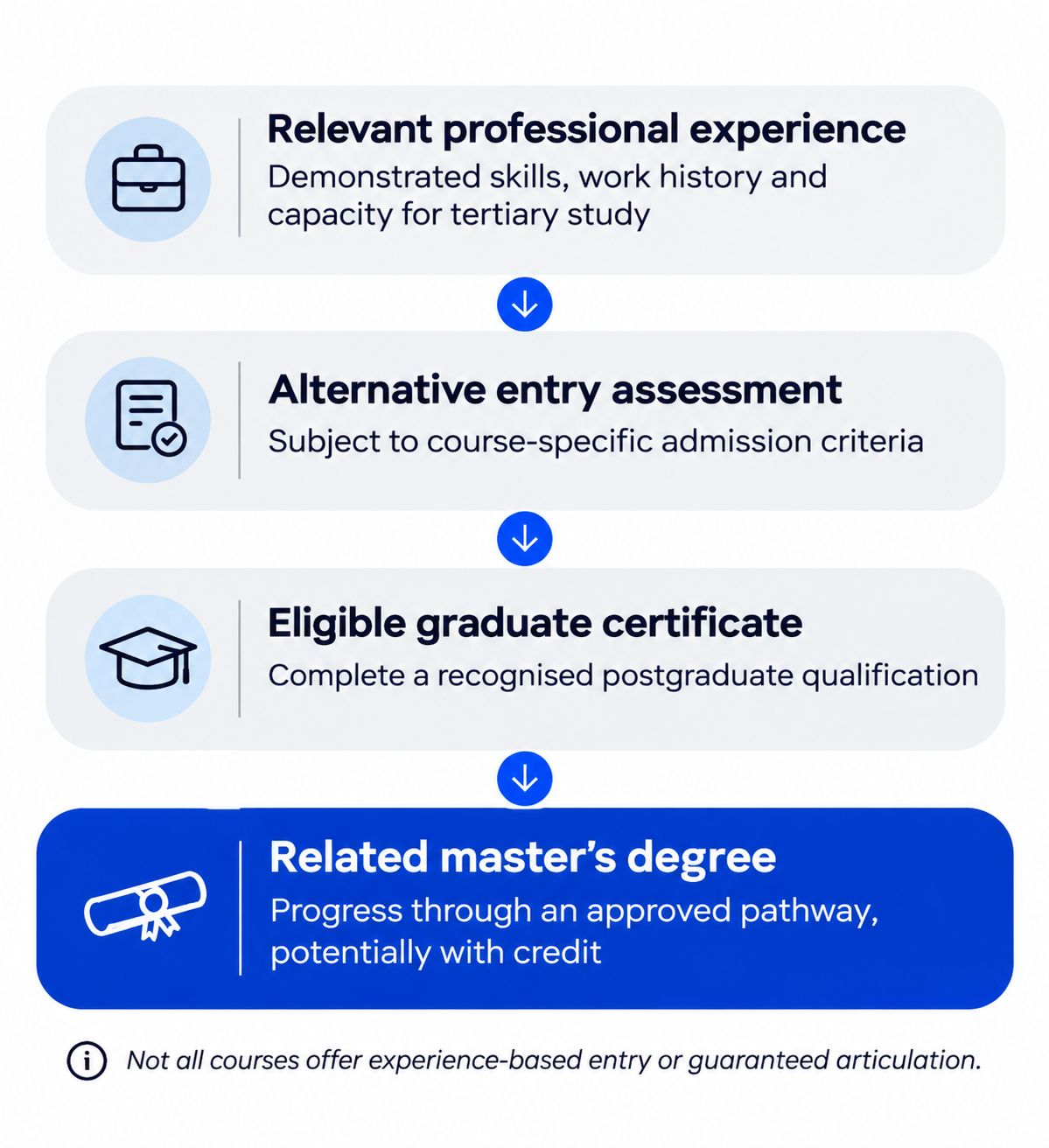
Many alternative entry pathways run through a graduate certificate first, which can then credit towards a related master’s degree.
Relevant professional experience, often three to five years depending on the course, can be assessed alongside documentation like a CV and statement of service.
Recognition of prior learning (RPL) is a separate process assessed after an offer is made, and it is not a guaranteed shortcut to reduce course duration.
Courses tied to professional registration, such as teaching or nursing, generally require specific accredited prior study rather than experience-based entry.
Can you study a master’s without a bachelor's degree in Australia?
Yes, in some cases, but it depends on the university, the course and the specific admission requirements set for that qualification. There is no single national rule that applies across every postgraduate degree in Australia.
Some universities assess applicants holistically, weighing professional experience, demonstrated capability and existing qualifications alongside (or instead of) a completed undergraduate degree. Others require a defined entry qualification, like a graduate certificate, before progressing into a master’s.
It helps to separate two categories of postgraduate course:
- Postgraduate coursework degrees in fields like business, technology or public health often have more flexible entry criteria, including pathways based on professional experience.
- Courses linked to professional registration, such as teaching, nursing, psychology or law, generally require specific accredited prior study recognised by a regulatory body. Experience alone usually won't substitute for this.
So the honest answer is that alternative entry exists, but it is course specific. Checking the entry requirements for your exact course of interest matters more than relying on general assumptions.
What are alternative entry pathways?
Alternative entry is an admission pathway that doesn't rely solely on a completed bachelor's degree. Instead, universities may consider:
- Relevant professional work experience, often measured in years
- Completion of a related graduate certificate or other postgraduate qualification
- Demonstrated capacity to succeed in tertiary study, shown through professional development, workplace responsibilities or industry standing
The specifics vary by course. For example, a technology-focused graduate certificate might accept applicants with three years of relevant industry experience, while a public health graduate certificate might set the bar at just one year of relevant health sector experience. There's no single formula. Each course sets its own criteria based on what it believes prepares someone to study successfully at that level.
This is where it pays to look closely at individual course pages rather than assuming eligibility rules carry across disciplines.
Can work experience count towards postgraduate entry?
Yes, relevant professional experience can be considered during admissions, though what counts as "relevant" and how much is required depends on the course.
Universities typically look for experience that has developed skills, knowledge and competencies directly related to the subject matter of the course. This might include time spent in managerial, professional, technical or industry-specific roles. A general capacity to undertake tertiary study, often demonstrated through professional development or workplace responsibility, is usually assessed alongside the experience itself.
To support an experience-based application, you'll typically need:
- A current curriculum vitae outlining your competencies, achievements and professional development
- A statement of service confirming your employment, which might take the form of an employer-provided letter, a signed university statement of service, a statutory declaration, or in some cases a letter from an accountant or solicitor confirming your engagement with a business
Evidence matters here. Admissions teams aren't just taking your word for it. They're looking for documented proof that your professional background genuinely aligns with the demands of postgraduate study.
Graduate certificate vs master’s: which pathway is right for you?
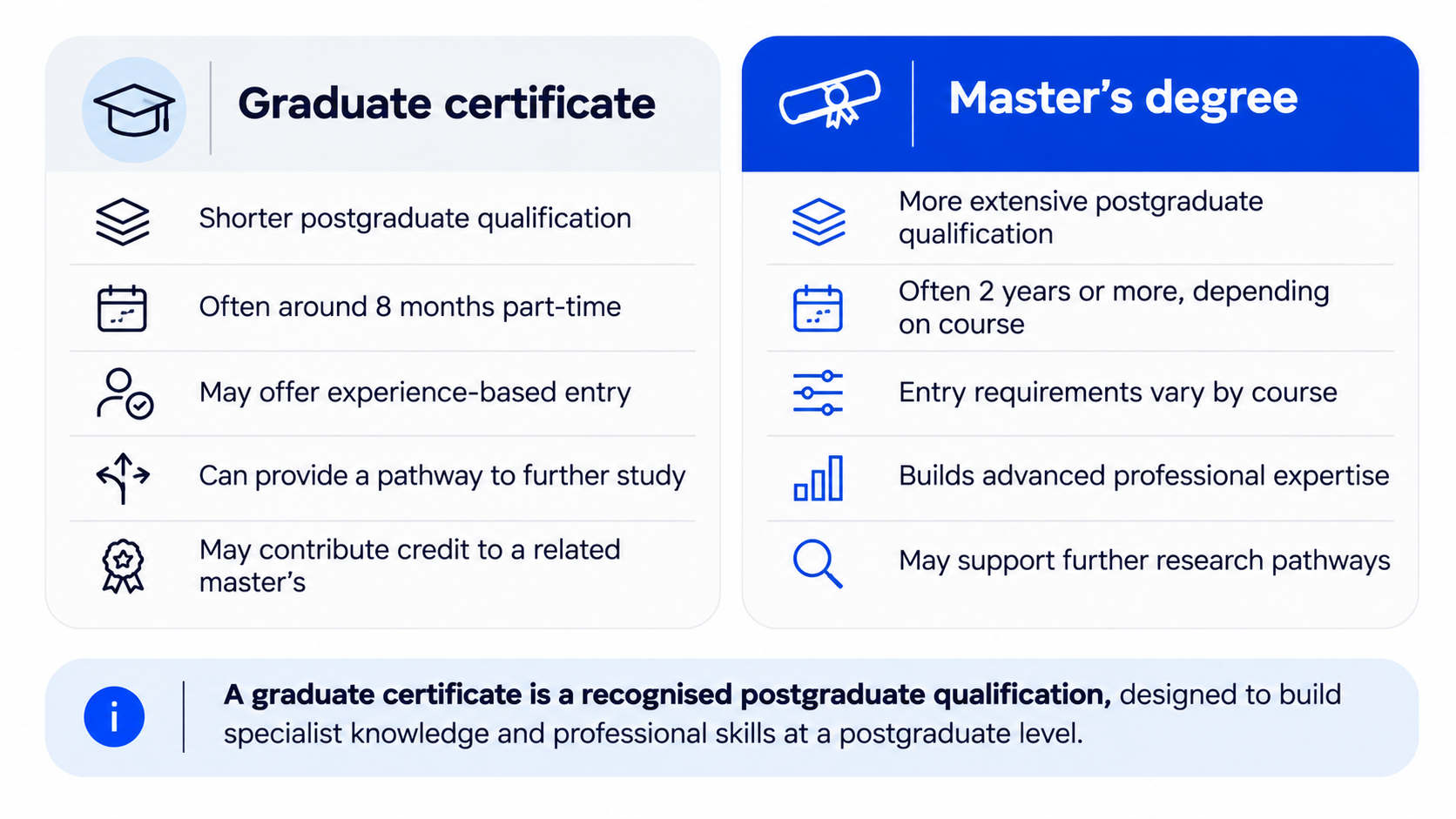
A graduate certificate is a shorter postgraduate qualification, often completed in around eight months of part-time study. It's designed to build specific skills quickly, whether that's for career progression, a shift into a new field, or as a stepping stone towards further study.
For applicants without a bachelor's degree, an eligible graduate certificate can act as a genuine entry point. Complete it successfully, and some universities will allow you to articulate into a related master’s degree, with credit applied towards your remaining subjects.
Here's how the two qualifications generally compare:
| Graduate certificate | Master’s degree | |
| Typical duration | Around 8 months (part-time, one subject at a time) | Minimum of two years, depending on course structure |
| Qualification level | Postgraduate, but not equivalent to a bachelor's or master’s | Higher postgraduate qualification |
| Entry requirements | May accept relevant professional experience without a bachelor's degree | Often requires a bachelor's degree, completed graduate certificate, or substantial relevant experience |
| Progression | Can lead into a related master’s degree through articulation, subject to credit rules | Final postgraduate qualification in most cases |
As an illustrative example, someone with five years of relevant business experience but no bachelor's degree might start with a Graduate Certificate in Business Administration. If completed successfully, it could then count towards credit for a related MBA, reducing the number of remaining subjects required, subject to the university's current course rules.
It's worth noting a graduate certificate is not equivalent to a bachelor's degree. It sits at its own postgraduate level, built for a specific purpose: giving people a faster, focused way into further study or targeted skill development.
What is recognition of prior learning (RPL)?
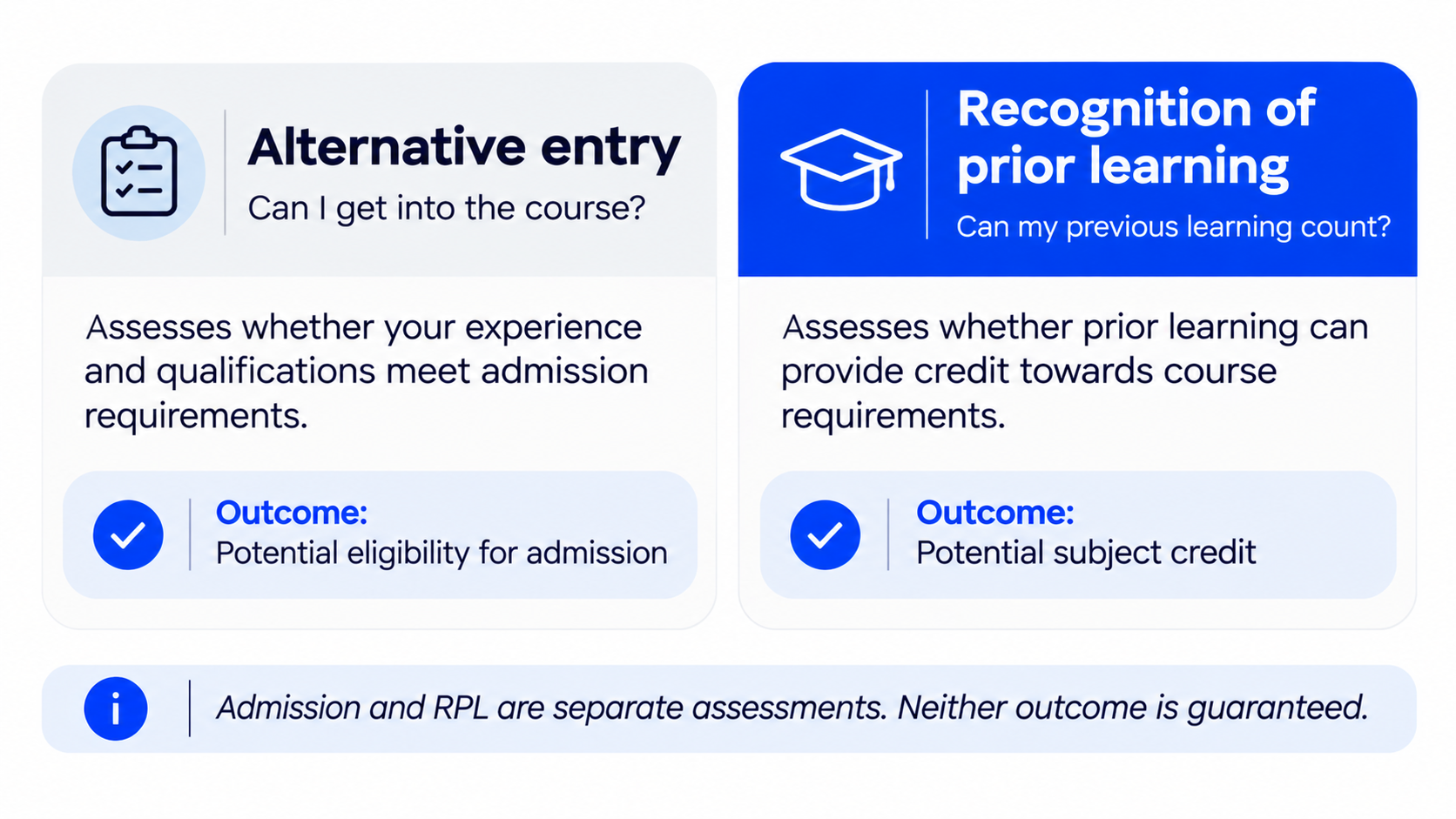
Recognition of prior learning is a process where previous study or professional experience is assessed for potential credit towards a qualification. It's a distinct process from admission.
Here's the important distinction: being admitted into a course because of your professional experience is not the same as receiving credit for that experience once you're enrolled. Admission gets you through the door. RPL is a separate assessment that happens after you've accepted an offer, and it determines whether specific subjects can be credited based on equivalent prior learning.
It's also worth being realistic about what RPL can and can't do. It doesn't automatically shorten your course, and it isn't guaranteed just because you have years of industry experience. Each application is assessed against the specific requirements of the course, and outcomes vary. If you're hoping RPL might apply to your situation, the best approach is to speak with a Student Enrolment Advisor once you've received an offer, so you understand exactly what's possible.
Which postgraduate courses offer alternative entry pathways?
Alternative entry pathways show up across a range of disciplines, though not universally. Here's how it plays out across a few fields, using UTS Online course examples:
Business
The UTS Online Graduate Certificate in Business Administration accepts applicants with a minimum of five years of full-time (or equivalent part-time) relevant post-secondary professional work experience, alongside demonstrated capacity for tertiary study. From there, eligible graduates can progress into the UTS Online MBA, with the completed graduate certificate contributing credit points towards the degree.
It's worth being clear here: the MBA itself generally requires a completed graduate certificate or higher qualification, or a bachelor's degree combined with relevant criteria. For applicants without a bachelor's degree, the experience-based route runs through the graduate certificate first rather than direct entry into the MBA.
Technology
The UTS Online Graduate Certificate in Technology Management includes an experience-only entry route, accepting applicants with a minimum of three years of relevant professional experience in a technology-related role, or equivalent experience gained through contributions to organisations, start-ups or entrepreneurial ventures. This course can lead into the Master of Technology Management.
Public health
The UTS Online Graduate Certificate in Public Health sets a lower experience threshold, accepting applicants with a minimum of one year of relevant professional work experience in health or public health settings, combined with demonstrated capacity for tertiary study. This can act as a pathway towards the Graduate Diploma in Public Health and eventually the Master of Public Health.
Education and registration-linked courses
It's worth flagging that not every field works this way. Courses tied to professional registration, including some education qualifications, generally require teacher education credentials accredited by the relevant regulatory authority, such as NESA in New South Wales. Alternative entry based purely on experience typically doesn't apply here, so it's essential to check specific requirements for registration-linked courses.
Entry requirements and intake details change, so always confirm current requirements directly on the course page before making decisions.
How to strengthen your postgraduate application
If you're considering an experience-based pathway, a bit of preparation goes a long way:
- Review the specific course entry requirements. Don't assume requirements from one course apply to another, even within the same university.
- Gather evidence of relevant professional experience. Think about how your roles, responsibilities and achievements connect directly to the course content.
- Prepare supporting documentation. This typically includes a CV and a statement of service, whether from your employer, a signed university form, or other accepted evidence.
- Demonstrate how your experience aligns with the course. Be specific. Admissions assessors want to see a clear thread between what you've done professionally and what you're about to study.
- Speak with a Student Enrolment Advisor about eligibility. They can clarify what's required for your specific circumstances and guide you through the application process before you commit time to preparing documents.
What are the benefits of postgraduate study for experienced professionals?
For professionals who've built capability on the job, postgraduate study offers something different to a first degree. It's less about starting from scratch and more about formalising what you already know, while filling in strategic gaps.
A few areas where this often pays off:
- Strategic capability. Postgraduate study tends to push beyond technical skills into strategic thinking, leadership and decision-making, areas that become more relevant as careers progress.
- Formal recognition. A postgraduate qualification can put a name to expertise you've built informally, which matters when applying for promotions or new roles.
- Broader professional knowledge. Courses often expose experienced professionals to frameworks, data and perspectives outside their usual day-to-day work.
According to QILT's 2025 Graduate Outcomes Survey, which captured responses from over 120,000 domestic graduates across all 42 Australian universities, 93.6 per cent of postgraduate coursework graduates were employed overall, with a median full-time salary of $104,700. It's worth being clear about what this data does and doesn't show. This is a population-level snapshot of recent graduates surveyed four to six months after completing their course, not evidence that postgraduate study guarantees higher pay or employment for any individual. Many respondents already held a bachelor's degree, and the survey doesn't isolate outcomes specifically for people who entered through experience-based pathways. Treat it as context, not a promise.
Explore your postgraduate options with UTS Online
If you've built real experience in your field but never completed a bachelor's degree, it's worth exploring whether a graduate certificate pathway might work for you. Several UTS Online courses, including the Graduate Certificate in Business Administration, Graduate Certificate in Technology Management and Graduate Certificate in Public Health, offer entry routes based on relevant professional experience rather than a completed degree, with the potential to progress into a related master’s degree afterwards.
Every course sets its own criteria, and meeting the eligibility requirements doesn't guarantee an offer of a place. The best next step is a genuine conversation. Speak with a Student Enrolment Advisor about your specific background, and find out exactly where your experience might take you.
Frequently asked questions
In some cases, yes, but it depends on the specific course and university. Many pathways for applicants without a bachelor's degree run through a graduate certificate first, rather than direct entry into a master’s. Courses linked to professional registration generally still require accredited prior study.
This varies significantly by course. For example, UTS Online's Graduate Certificate in Public Health requires a minimum of one year of relevant health sector experience, while its Graduate Certificate in Technology Management requires three years, and its Graduate Certificate in Business Administration requires five years. Always check the specific requirements for your course of interest.
Yes, several graduate certificates accept applicants based on relevant professional work experience and demonstrated capacity for tertiary study, instead of a completed bachelor's degree. Entry criteria differ by course, so confirming current requirements is essential.
No. A graduate certificate is a distinct postgraduate qualification. It is not equivalent to a bachelor's degree or a master’s degree, though it can serve as a pathway towards further postgraduate study.
Professional experience can sometimes support admission into a course. Whether it counts towards credit for specific subjects is a separate process, known as recognition of prior learning (RPL), which is assessed only after you've accepted an offer of enrolment. It is not guaranteed and does not automatically reduce course duration.
In many cases, yes. Some graduate certificates articulate into a related master’s degree, with completed subjects contributing credit points towards the master’s. The specific credit arrangement depends on current course rules, so it's worth confirming details directly with the university before enrolling.