The fastest-growing digital marketing jobs in Australia for 2027

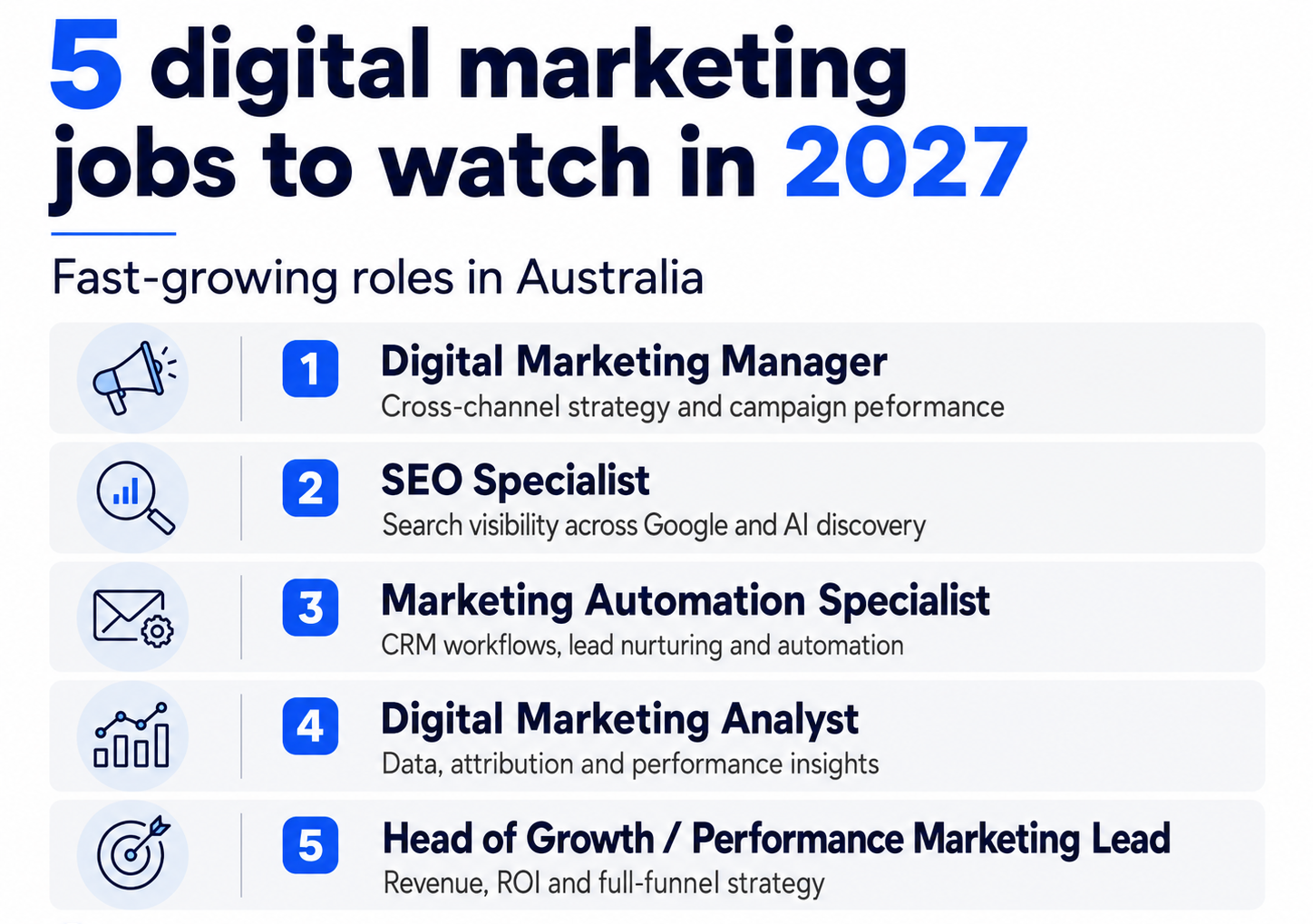
Careers in digital marketing are growing across Australia, with Digital Marketing Manager, SEO Specialist, Marketing Automation Specialist, Digital Marketing Analyst and Head of Performance Marketing among the fastest-growing roles. Typical salaries range from around $80,000 for specialist roles to $150,000 or more in senior leadership, with employers increasingly prioritising AI literacy and data confidence over channel-specific execution.
Australia's internet advertising market grew 11.5 per cent year on year to reach $18.4 billion in 2025 (IAB Australia, 2026). Behind that number sits a workforce shift. Jobs and Skills Australia counts 103,100 advertising and marketing professionals nationally as of February 2026, with median full-time earnings of $1,957 a week and annual employment growth of around 3,000 roles. The roles those professionals are hired into look different to five years ago.
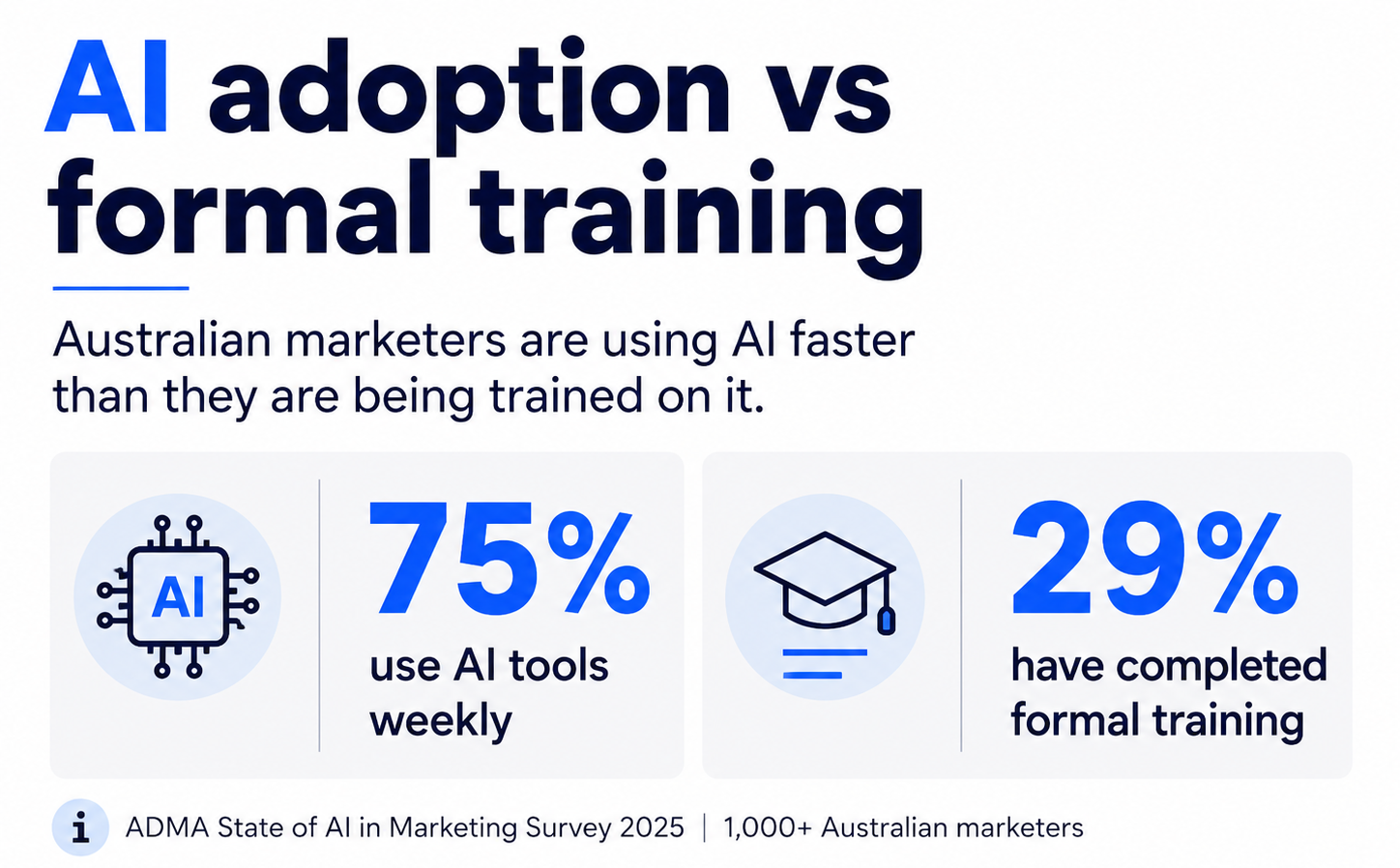
AI fluency is becoming an increasingly important capability across marketing roles. ADMA’s 2025 State of AI in Marketing Survey, featured in its 2026 AI, Talent & Trust reporting, found that while 75 per cent of Australian marketers use AI tools weekly, only 29 per cent have completed formal training. That gap between adoption and capability is helping shape the skills employers will increasingly look for in 2027.
So which roles are actually growing, what do they pay, and what should you be learning right now Here's a breakdown of five digital marketing careers worth watching, from hands-on specialist roles through to senior leadership. For a broader list of roles across the field, see our guide to top digital marketing careers.
How strong is demand for digital marketing roles right now?
Job ad volume backs up the labour market data. Jobs and Skills Australia projects employment for Advertising and Marketing Professionals to grow by around 12.6 per cent over the five years to May 2030. In 2026, more than 3,200 digital marketing roles were also listed on SEEK at one point in time. That growth isn’t evenly spread. Employers are increasingly advertising for hybrid roles that blend two or three disciplines, such as SEO and content, or analytics and automation, rather than narrow single-channel specialists.
This matters for anyone assessing career options. A role advertised as "Digital Marketing Specialist" in one company might be almost entirely paid media, while the same title elsewhere leans heavily into content and SEO. Reading the actual responsibilities in a job ad, not just the title, is now more useful than relying on standard job descriptions to understand what a role really involves.
Which industries are hiring digital marketers?
Digital marketing roles aren't confined to agencies or tech companies. Retail, financial services, healthcare, education, professional services and government all maintain in-house digital marketing functions, and demand across these sectors has broadened as more organisations move core customer acquisition and retention activity in-house rather than outsourcing it. Retail and ecommerce brands tend to hire the highest volume of specialist and analyst roles, while financial services and larger corporates more often hire at manager and leadership level, reflecting more complex governance and compliance requirements around marketing data and AI use.
1. Digital Marketing Manager
The digital marketing manager role sits at the centre of most in-house marketing teams. It's part strategist, part project manager, part budget owner, responsible for planning and running campaigns across SEO, paid media, email, social and marketing automation, then reporting on what worked.
What's changed is the shape of the job itself. AI tools now draft first-pass copy, build reporting dashboards and flag underperforming campaigns automatically, which is shifting the manager's time away from execution and toward briefing, evaluating and correcting AI-assisted output. Employers increasingly want someone who can direct a channel mix, not just run one.
Typical salary: Roughly $95,000 to $125,000 nationally, with senior managers in Sydney and Melbourne earning up to $150,000 or more depending on team size and industry. Entry-level managers with one to three years of experience tend to start closer to $70,000 to $85,000.
Why it's growing: Businesses are consolidating marketing spend into fewer, more accountable roles. Robert Half's 2026 salary guide found employers increasingly want generalists who can move across brand, digital and data rather than narrow channel specialists, which is pushing more responsibility, and pay, into this one role.
Skills employers want:
- Working knowledge of GA4 and campaign reporting dashboards
- Confidence briefing and evaluating AI-assisted content and creative
- Budget management across paid, owned and earned channels
- Stakeholder communication, since this role increasingly reports outcomes to leadership rather than just executing tactics
How to get there: Most digital marketing managers move up from a coordinator or specialist role after two to four years, building experience across at least two channels before taking on budget and team responsibility. A postgraduate qualification can accelerate this for professionals moving in from an adjacent field such as sales, communications or business operations.
2. SEO Specialist
SEO hasn't disappeared with the rise of AI search, it's changed shape. Specialists are now expected to understand how content performs not just in traditional search results but in AI-generated answers and summaries too.
Typical salary: Around $80,000 to $90,000 nationally according to SEEK job ad data, rising to $100,000 to $125,000 for senior specialists with technical SEO and analytics depth. Regional variation is notable, with Perth and Adelaide currently posting some of the highest average salaries for this role.
Why it's growing: As search behaviour fragments across Google, AI assistants and social platforms, businesses need someone who understands visibility across all of them, not just one algorithm.
Skills employers want:
- Technical SEO auditing and site structure knowledge
- Content optimisation for both traditional search and AI-driven discovery
- Comfort with analytics platforms and basic data interpretation
- Understanding of how large language models surface and summarise content, sometimes called answer engine optimisation
How to get there: SEO is one of the more accessible entry points into digital marketing because core skills, keyword research, content structure and basic analytics, can be learned through free tools and practical projects before ever holding the job title. Many specialists build a portfolio by optimising a personal blog or small business website before applying for their first in-house or agency role.
3. Marketing Automation Specialist
This role sits at the intersection of marketing and technology, building the email flows, lead scoring models and CRM workflows that keep a sales funnel moving without manual intervention.
The role has moved beyond setting up static workflows. AI-assisted automation platforms can now build and adjust nurture sequences in response to real-time behavioural signals, so specialists are increasingly judged on how well they configure and audit these systems rather than how much they build manually.
Typical salary: Around $85,000 to $98,000 nationally, with top earners in platform-heavy roles (Marketo, HubSpot, Salesforce) reaching $120,000 to $135,000.
Why it's growing: As marketing teams stay lean, automation is doing more of the work that used to require additional headcount. Specialists who can build and maintain these systems are increasingly valuable, particularly those fluent in a specific platform stack.
Skills employers want:
- Platform expertise in at least one major automation or CRM tool
- Lead scoring, segmentation and nurture campaign design
- Basic HTML and email deliverability knowledge
- Data hygiene and integration skills across marketing and sales systems
How to get there: Platform certifications, such as those offered directly by HubSpot, Salesforce and Marketo, are widely recognised by employers and can substitute for formal qualifications at entry level. Professionals coming from an email marketing, CRM or sales operations background often have a head start.
4. Digital Marketing Analyst
Where the marketing automation specialist builds the systems, the analyst interprets what they produce, turning campaign data into decisions about budget, targeting and creative.
Typical salary: Around $90,000 to $110,000 nationally, with marketing research analyst roles in strategic or agency settings reaching $130,000 to $140,000 for experienced professionals.
Why it's growing: Skills-first hiring is reshaping marketing teams, and employers are asking less about job titles and more about whether a candidate can demonstrate impact through data. Analysts who can translate numbers into a clear recommendation, rather than just a dashboard, are in short supply.
Skills employers want:
- Strong Excel or SQL fundamentals for working with raw data
- Experience with GA4, attribution modelling and dashboard tools
- Ability to communicate findings to non-technical stakeholders
- Familiarity with AI-assisted analytics tools for faster reporting
How to get there: This role attracts a genuinely mixed talent pool, professionals moving across from business analytics, finance or market research, as well as marketers who develop a strong data skill set on the job. A postgraduate subject in data-driven marketing or analytics can help formalise skills gained informally.
5. Head of Growth or Performance Marketing Lead
At the senior end, roles such as Head of Growth, Head of Performance Marketing and Head of Digital Optimisation sit closest to revenue. These leaders own acquisition targets and are judged on return on investment, not just campaign output.
Typical salary: From $130,000 up to $200,000 or more, depending on company size and whether the role carries P&L responsibility.
Why it's growing: Businesses want fewer, more senior marketing hires who can connect strategy directly to commercial outcomes. This is also where AI proficiency is most tied to pay. Robert Half’s 2026 Australia Salary Guide found that 85 per cent of businesses expect AI proficiency to continue driving salary growth in their organisation over the next couple of years.
Skills employers want:
- Full-funnel strategy across paid, organic and lifecycle channels
- Commercial fluency, including forecasting and budget ownership
- Team leadership and cross-functional collaboration with sales and product
- A track record of using data and AI tools to improve return on ad spend, not just automate tasks
How to get there: This is rarely a first or second job. Most professionals reach Head of Growth or Performance Marketing Lead roles after six to ten years, typically via a digital marketing manager or senior analyst path, with a demonstrated track record of tying campaign work to revenue outcomes rather than output metrics alone.
The skills that cut across every role
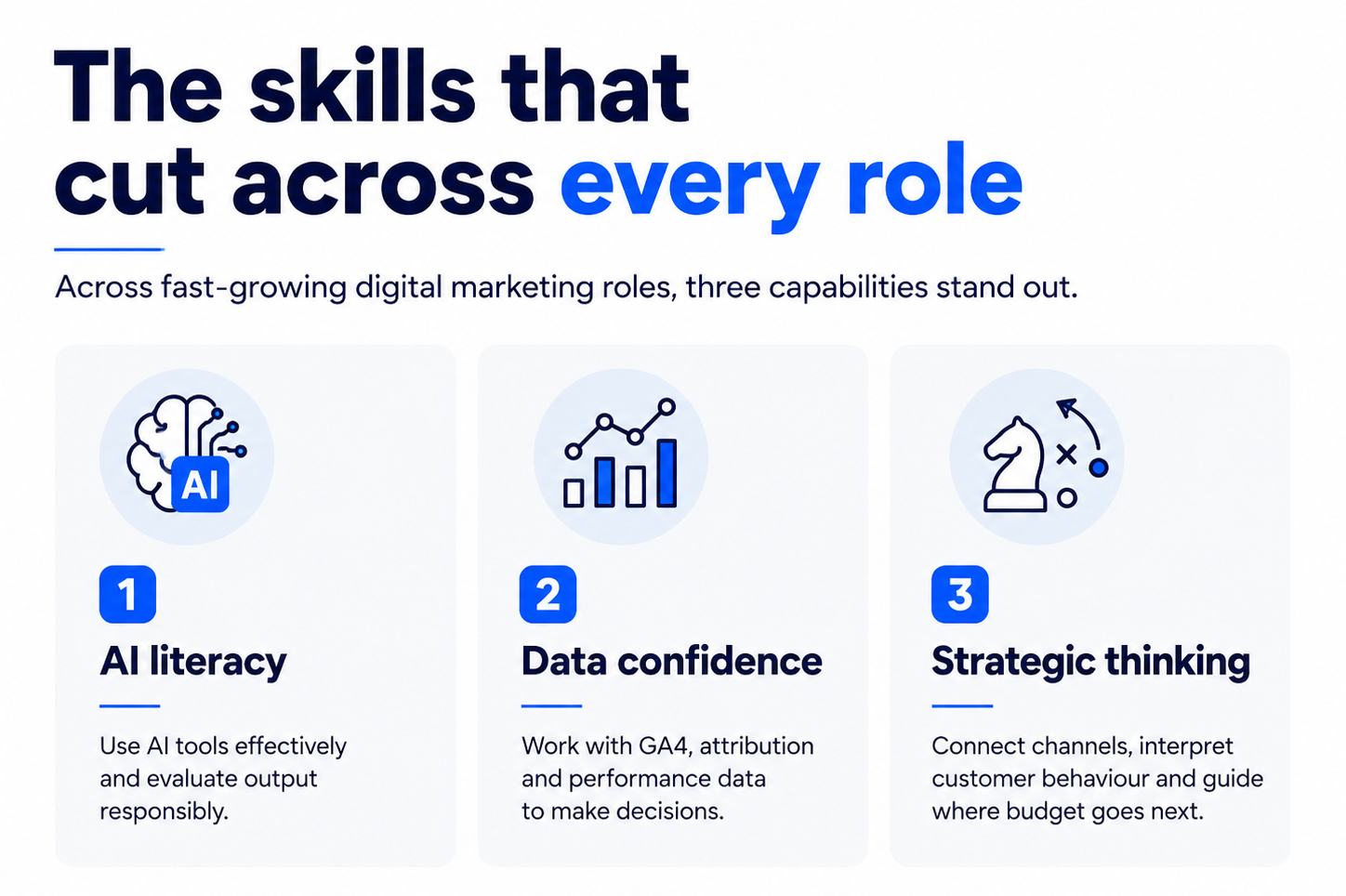
A few themes repeat across all five roles above, and they're worth calling out on their own.
AI literacy is now a baseline expectation, not a bonus. With three-quarters of Australian marketers already using AI tools weekly but fewer than a third formally trained on them, the differentiator in 2027 isn't whether you use AI, it's whether you understand what it's doing and can direct it responsibly.
Data confidence matters more than channel expertise. Employers increasingly value marketers who can move between disciplines and connect brand, performance and data, rather than specialists who only know one channel deeply.
Strategic thinking is replacing tactical execution as the growth path. The clearest pattern in current job ads is a shift away from platform-specific execution roles and toward people who can interpret customer behaviour, connect channels and make a case for where budget should go next.
How to break into digital marketing without a marketing degree
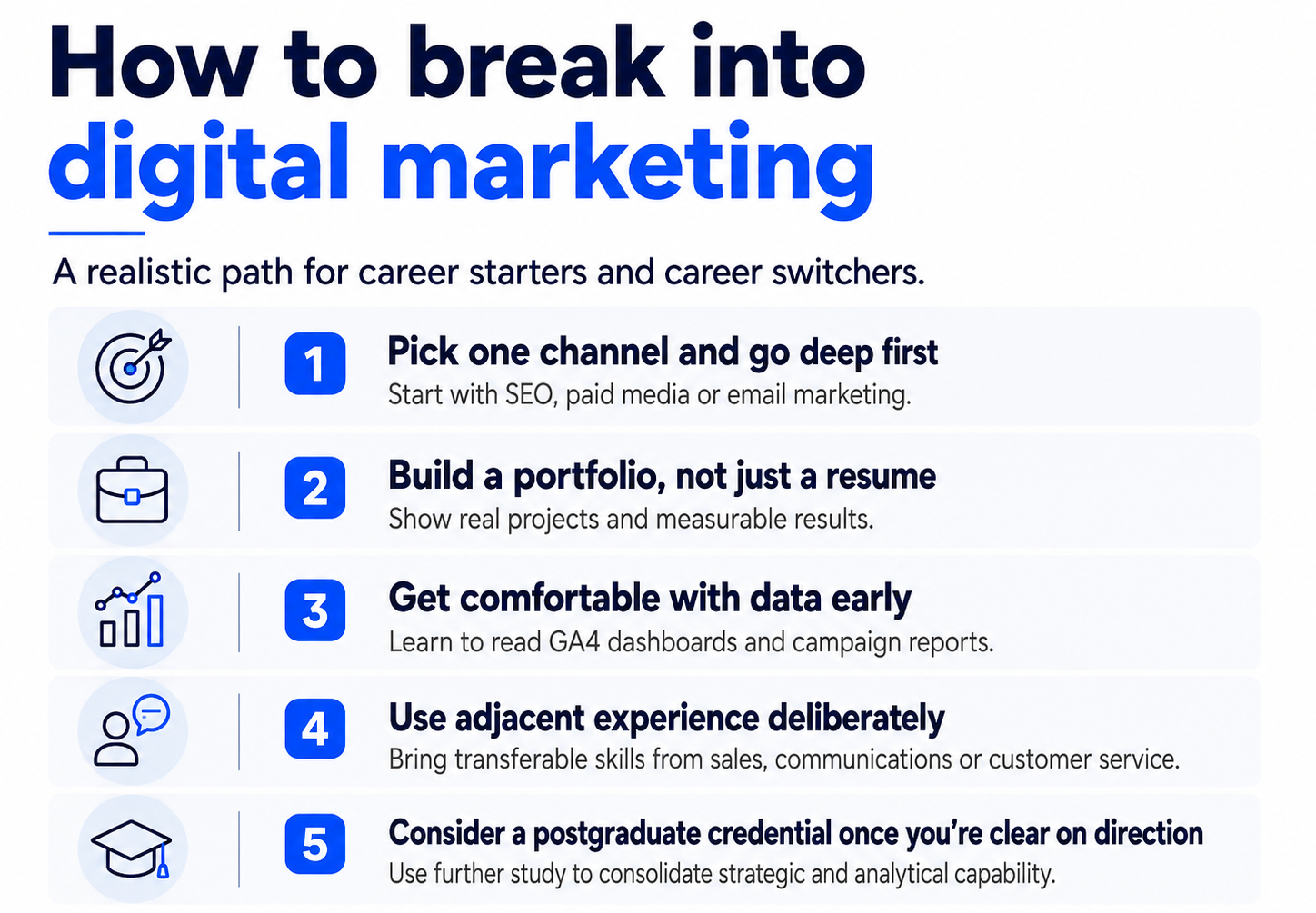
Digital marketing remains one of the more accessible corporate career paths for people without a traditional marketing qualification, largely because so many of its core tools and platforms are learnable outside a classroom. A realistic path in usually looks like this:
1. Pick one channel and go deep first. SEO, paid media or email marketing are the most common entry points because free or low-cost tools (Google Search Console, Google Ads, Mailchimp) let you build genuine, demonstrable skills before applying for a role.
2. Build a portfolio, not just a resume. A personal project, freelance client or volunteer campaign with real, even modest, results carries more weight with hiring managers than a list of completed courses.
3. Get comfortable with data early. Even entry-level roles now expect basic comfort reading a GA4 dashboard or a campaign report. This is one of the fastest ways to stand out from other junior applicants.
4 .Use adjacent experience deliberately. Backgrounds in sales, customer service, journalism, communications or admin all carry transferable skills, stakeholder communication, writing and organisation that are genuinely valued in junior digital marketing roles.
5. Consider a postgraduate credential once you're clear on direction. For professionals with a few years of adjacent experience who want to move into a manager or specialist track faster, a short, focused qualification can consolidate scattered self-taught knowledge into something employers immediately recognise.
Where postgraduate study fits
For professionals already working in marketing, moving from tactical execution into a strategic or leadership role often comes down to two things: demonstrated capability with data and AI, and a credential that signals it. The UTS Online Graduate Certificate in Digital Marketing is built around exactly that shift, covering data-driven marketing, digital customer behaviour and AI in marketing across four subjects, completed in as little as eight months while working full time.
Frequently asked questions
Yes. With the internet advertising market growing past $18.4 billion and more than 100,000 advertising and marketing professionals employed nationally, demand remains strong. The roles paying best are shifting toward data-literate, AI-confident specialists rather than generalists, so career growth increasingly depends on building those specific skills.
Common outcomes include Digital Marketing Manager, SEO Specialist, Marketing Automation Specialist, Digital Marketing Analyst, Channel Marketing Manager and, with experience, senior roles such as Head of Performance Marketing or Director of Digital Marketing.
No. Most roles value data literacy and platform familiarity over a technical degree. Many professionals move into digital marketing from communications, business, sales or customer experience backgrounds, then build technical and analytical skills through experience or postgraduate study.
AI is automating routine tasks like reporting, content drafting and campaign optimisation, which is shifting demand toward marketers who can direct and evaluate AI output strategically rather than just execute campaigns manually. Roles that combine AI fluency with commercial or analytical thinking are attracting the strongest salary growth.
Prioritise AI literacy, data analysis (particularly GA4 and attribution), and the ability to work across channels rather than specialising narrowly. Employers are increasingly hiring for demonstrated impact over job titles or years of experience alone.
Which industries hire digital marketers in Australia? Retail, financial services, healthcare, education, professional services and government all employ digital marketers directly, alongside marketing agencies. Retail and ecommerce brands tend to hire the highest volume of specialist and analyst roles, while larger corporates and financial services more often hire at manager and leadership level.
Yes. SEO, paid media and email marketing can be learned through free or low-cost tools and practical projects, and many professionals move in from sales, communications or customer-facing roles. A portfolio of real, even small-scale, results typically matters more to employers than formal qualifications at entry level.
The bottom line
Digital marketing careers in Australia are growing, but the roles getting hired and promoted fastest are shifting. Career opportunities worth targeting in 2027 include Digital Marketing Manager, SEO Specialist, Marketing Automation Specialist, Digital Marketing Analyst and Head of Performance Marketing, all of which increasingly reward data confidence and AI fluency over channel-specific execution alone.
Explore the UTS Online Graduate Certificate in Digital Marketing to build your capability across digital strategy, customer insight, analytics and emerging technology.
Sources
- IAB Australia (2026) Internet Advertising Revenue Report, full calendar year 2025.
- ADMA (2026) AI, Talent & Trust: A New Blueprint for Marketing Leadership.
- Jobs and Skills Australia (2026) Advertising and Marketing Professionals occupation profile, ANZSCO 2251.
- Robert Half (2026) Australia Marketing Salary Guide.
- SEEK (2026) Career advice: salary data by role.
- SEEK (2026) job ad volume data, Digital & Search Marketing classification.
- Glassdoor Australia (2026) Salary estimates by role and location.
- ERI SalaryExpert (2026) Australia salary benchmarking data.
- UTS Online (2026) Graduate Certificate in Digital Marketing course page, studyonline.uts.edu.au.