Eligibility restrictions apply: only Australian citizens or permanent residents are eligible to apply for this course.
Why study the Master of Urban Planning with UTS Online?
Top 100 University globally1
Australia’s leading young university2
Top 100 globally for Architecture & Built Environment3
Top 100 globally for Civil & Structural Engineering3
1QS World University Rankings, 2027 2 Times Higher Education Young University Rankings, 2026 3 QS World University Rankings by Subject, 2027
Every place is shaped by competing priorities
Cities do not grow neatly. Housing demand rises, infrastructure needs change, climate pressures intensify and communities expect more from the places where they live and work. Behind every planning decision are competing priorities and choices that can shape a neighbourhood, city or region for decades.
The UTS Online Master of Urban Planning helps you navigate that complexity, building advanced capability across planning systems, urban design, spatial analysis, sustainable development, planning law and strategic planning. Designed for working professionals, the course connects your study with contemporary planning challenges and strengthens your ability to use evidence, weigh different outcomes and contribute to more liveable, sustainable and resilient places.
Graduate with an industry-recognised qualification
The UTS Online Master of Urban Planning is accredited by the Planning Institute of Australia (PIA), the national body representing planning and the planning profession, with 5,300 members nationally and internationally.


Who is this course for?
The UTS Online Master of Urban Planning is designed for professionals who want to build advanced planning capability and contribute to how cities, regions and communities grow, adapt and develop.
Whether you already work in planning, development, architecture, property, infrastructure, environmental practice or another built-environment field, or want to move into professional urban planning, the course can help you build the analytical, strategic and collaborative capability the profession demands.
This course may suit professionals looking to:
- Move into or progress within professional planning roles
- Strengthen strategic and statutory planning capability
- Use spatial analysis and evidence to inform planning decisions
- Better understand planning systems, policy, law and sustainable urban development
- Build capability in stakeholder engagement, negotiation and complex planning decisions
See entry requirements under course information for more eligibility information.
What you will study
The UTS Online Master of Urban Planning comprises 15 online subjects totalling 90 credit points, building advanced capability across planning systems, urban design, spatial analysis, sustainable development, planning law, strategic planning and community engagement.
Complete all 15 subjects:
- Property Development and Planning Process (6CP)
- Sustainable Urban Development (6CP)
- Planning & Design Theory and Decision Making (6CP)
- Urban Design Fundamentals (6CP)
- Urban Analytics (6CP)
- Environmental and Social Impact Assessments (6CP)
- Urban Economics and Infrastructure Planning (6CP)
- Planning and Environmental Law in Australia (6CP)
- Local Strategic Planning (6CP)
- Structure Planning (6CP)
- Spatial Analysis (GIS) (6CP)
- Development Negotiation and Community Engagement (6CP)
- Urban Planning Capstone
Students who complete eight subjects from the masters may be eligible to exit with a Graduate Diploma in Urban Planning.
CP = credit points. Subject descriptions and learning outcomes are available via the subject links on this page. Subject availability, sequencing and course structures are subject to change.
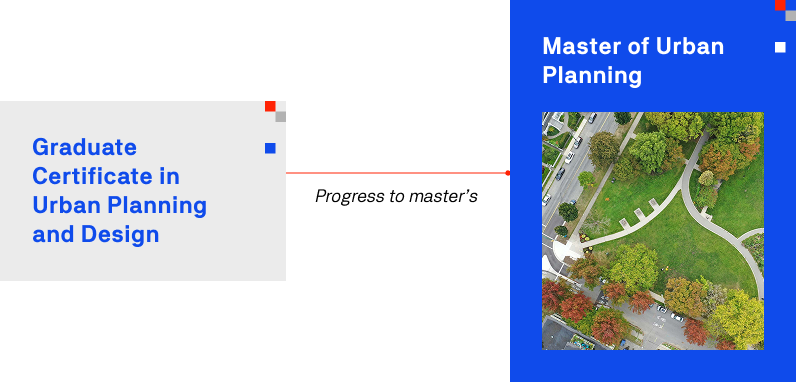
Flexible course options
Whether you’re ready to take the next step or prefer to start with a shorter qualification, begin with the Graduate Certificate in Urban Planning and Design and continue into the Master of Urban Planning when you’re ready.
Learning outcomes
The UTS Online Master of Urban Planning and Design gives you the capability to navigate complex planning challenges, use evidence and spatial analysis to inform decisions, engage diverse stakeholders and shape more sustainable, liveable and resilient places.
Shape sustainable and strategic urban development
Analyse the forces that drive land and property markets and evaluate their impact on urban planning proposals. Apply spatial analysis to design planning solutions that enhance liveability, sustainability and economic resilience.
Lead with ethical and future-focused planning
Develop a critical and ethical mindset to navigate complex urban challenges. Apply socially responsible and forward-thinking planning strategies that anticipate and respond to emerging urban, regional and environmental dynamics.
Engage and influence diverse stakeholders
Refine your ability to communicate planning concepts and strategies effectively. Build collaborative relationships with stakeholders from diverse cultural, social and economic backgrounds to drive consensus and support sustainable urban outcomes.
Develop data-driven and innovative planning solutions
Harness analytical tools and planning methodologies to create evidence-based urban strategies. Use cutting-edge research and technology to model urban growth, assess risks and develop solutions that shape the cities of tomorrow.
Career outcomes
The UTS Online Master of Urban Planning builds capability relevant across strategic and statutory planning, development assessment, urban policy, infrastructure and environmental planning.
Depending on your professional background and experience, graduates may explore opportunities such as:
- Urban Planner
- Strategic Planner
- Development Assessment Officer
- Environmental Planner
- Transport Planner

Course information
Currently, this course is only accepting applications from Australian citizens or permanent residents.
Applicants must have one of the following:
- Completed Australian bachelor's, bachelor honours degree, or master’s degree, or overseas equivalent
OR
- Completed one of the following UTS qualifications, with a minimum GPA of 5/7:
OR
- Completed Australian graduate certificate or graduate diploma, or overseas equivalent, in a related field of study# with a minimum GPA of 5/7 AND A minimum of 3 years full-time, or equivalent part-time, relevant professional work experience#
# Related fields of study and areas of relevant professional work experience include Architecture and Urban Environment, Building Surveying, Building Construction Economics, Valuation, Human Geography, Geomatic Engineering, Environmental Studies, Law, and Economics.
Supporting documentation to be submitted with the application
For applicants who need to demonstrate professional work experience:
- Curriculum Vitae AND Statement of service in one of the following formats:
- A 'Statement of Service' provided by the employer
- A completed 'UTS statement of service’ signed by the employer
- A statutory declaration confirming professional work experience (Australian residents only)
- An official letter from the applicant’s accountant or solicitor, on company letterhead, confirming the applicant’s professional work experience or engagement with the business, duration of operations, and nature of the business
- A business certificate of registration in original language and English (e.g. provision of ASIC documentation or ABN or similar documentation for Australian Businesses)
Eligibility for admission does not guarantee an offer of a place.
Want to check your eligibility?
Not only do we have the right tools and support teams to help you – we have people who care about your success.

Start strong at $85,000–$105,000
Urban Planners in Australia earn between $85,000 and $105,000, with strong earning potential as professionals gain experience and take on advanced roles. For graduates with a Master’s degree and relevant work experience, this represents a solid foundation for a rewarding, high-growth career in urban planning.
(Planning Institute of Australia)
$242 billion major public infrastructure pipeline across Australia
Australia’s major public infrastructure pipeline is valued at $242 billion over five years, reflecting significant investment in transport, housing, energy and other public infrastructure projects.
(Infrastructure Australia, Infrastructure Market Capacity Report)
1,400
Annual employment growth
Urban and Regional Planning in Australia has seen annual employment growth of 1,400 positions, underscoring expanding opportunities in the sector.
(Jobs and Skills Australia)
Upcoming intakes
UTS Online courses have 6 intakes per year. The diagram below shows all upcoming intakes. Our next intake is highlighted below.
-
Jan
2027 -
Mar
2027 -
May
2027 -
Jul
2027 -
Aug
2027 -
Oct
2027
Meet our Course Coordinator
"Urban planning is about creating places that are sustainable, inclusive and responsive to the needs of communities. Our courses equip students with the analytical, spatial and critical-thinking skills to understand complex urban challenges and develop practical, evidence-based solutions that can make a meaningful difference to cities and communities."
Dr Mukesh Ray
Course Director, Urban Planning
Mukesh Ray brings expertise in architecture, urban planning, geographic information systems and environmental sustainability. His work uses spatial analysis and urban analytics to address challenges such as urban growth, land use change and urban heat. Through his teaching at UTS, you’ll build the research skills and practical knowledge to develop evidence-based, sustainable and socially responsive planning solutions.
Dr Mukesh Ray
Course Director UTS Online, Urban Planning program

Download your course guide
Download a course guide to explore detailed subject descriptions, entry requirements, pathway options and fee information.

“I thought completing one subject at a time would be much easier for me to juggle with my work. Everything was in one place. The broad coverage of what I studied has been really helpful, because I’m opening my progression up to those new paths.”
Audrey B, UTS Online Graduate

“I continued some friendships from fellow students and also continued the relationship with UTS.”
Ben G, UTS Online Graduate
Frequently asked questions
A Master of Urban Planning is a postgraduate degree focused on how cities, towns and communities are planned, managed and developed over time.
The UTS Online Master of Urban Planning develops capability across planning systems, sustainable urban development, urban design, analytics, impact assessment, economics and infrastructure, planning law, strategic planning, GIS, negotiation and applied urban projects.
The UTS Online Master of Urban Planning is designed for professionals from both planning and non-planning backgrounds who want to build the knowledge and practical capability needed to work in urban planning and related fields.
It can suit professionals working in areas such as project management, environmental science, sustainability, property, development, policy, government and the broader built environment.
The online course is currently available to Australian citizens and permanent residents.
Yes. You do not need a previous qualification in urban planning to apply.
The current direct-entry requirements accept a completed Australian bachelor’s degree, bachelor honours degree or master’s degree, or overseas equivalent. Other entry pathways are also available through eligible UTS qualifications or related postgraduate study combined with relevant professional experience.
Not always. A bachelor’s degree is one direct-entry pathway, but it is not the only route into the planning suite.
Applicants may also qualify through certain UTS Graduate Certificate or Graduate Diploma qualifications, or through eligible postgraduate study in a related field combined with relevant professional experience.
If you do not hold a suitable formal qualification for direct entry to the master’s, you may be eligible to begin with the Graduate Certificate in Urban Planning and Design based on relevant professional experience.
Yes. The current direct-entry requirements accept a completed Australian bachelor’s degree, bachelor honours degree or master’s degree, or overseas equivalent, without restricting that qualification to a planning-related field.
This means professionals from other disciplines can use the Master of Urban Planning to build the planning knowledge and practical capability needed to move towards urban planning and related roles.
You’ll build capability in sustainable urban development, planning and design theory, urban design, spatial and urban analytics, environmental and social impact assessment, infrastructure planning, planning law, strategic planning, GIS and stakeholder engagement.
The course is designed to help you analyse complex urban issues, use evidence and spatial data to inform planning decisions, work with diverse stakeholders and develop planning solutions that balance social, environmental and economic priorities.
The UTS Online Master of Urban Planning comprises 15 subjects totalling 90 credit points:
• Property Development and Planning Process
• Sustainable Urban Development
• Planning & Design Theory and Decision Making
• Urban Design Fundamentals
• Urban Analytics
• Environmental and Social Impact Assessments
• Urban Economics and Infrastructure Planning
• Planning and Environmental Law in Australia
• Local Strategic Planning
• Structure Planning
• Spatial Analysis (GIS)
• Development Negotiation and Community Engagement
• Urban Redevelopment
• Urban Project A
• Urban Project B
Yes. The UTS Online Master of Urban Planning is currently accredited by the Planning Institute of Australia (PIA), the national professional body representing planning and the planning profession.
This provides a recognised professional planning pathway. Accreditation status can change over time, so check the current course information when applying.
A common pathway is to complete a planning qualification that develops capability in areas such as planning systems, policy, land use, sustainability, spatial analysis, planning law and community engagement.
A professionally accredited qualification can provide a recognised pathway into the planning profession. The UTS Online Master of Urban Planning is currently accredited by the Planning Institute of Australia and is designed to prepare graduates for planning roles across government, consulting, development and related settings.
Urban planning focuses on the systems and decisions that shape how land is used and how cities and communities grow, including policy, infrastructure, regulation, housing, transport, sustainability and long-term development.
Urban design focuses more closely on the physical form and experience of places, including streets, public spaces, neighbourhoods and the relationship between buildings and their surroundings.
The UTS Online Master of Urban Planning develops capability across both planning and urban design.
An architect focuses primarily on the design of buildings and built spaces, including how individual structures function and are experienced.
An urban planner works at a broader scale, considering land use, policy, infrastructure, regulation, environmental impacts, community needs and long-term development across neighbourhoods, cities and regions.
The two professions often work together on development and city-making projects.
The UTS Online Master of Urban Planning can be completed in a minimum of 30 months.
The course comprises 15 online subjects totalling 90 credit points.
Yes. The UTS Online Master of Urban Planning is designed for professionals who want to complete postgraduate study alongside existing work and personal commitments.
You’ll study online through structured weekly learning and can connect what you learn with contemporary planning, policy and built-environment challenges.
How you balance work, study and personal commitments will depend on your individual circumstances, so it is important to plan for the weekly study requirements of each subject.
The UTS Online Master of Urban Planning is delivered online.
If you prefer face-to-face study, UTS also offers a separate Master of Planning at its City Campus in Sydney. The on-campus course has its own structure, subjects and admissions requirements, so compare the two courses before deciding which study mode best suits you.
Yes. The UTS Online Graduate Certificate in Urban Planning and Design provides a pathway into the Master of Urban Planning.
The Graduate Certificate comprises four subjects totalling 24 credit points. If you successfully complete it and receive full credit towards the 15-subject master’s degree, you will have 11 additional subjects remaining, subject to current UTS credit rules.
Yes. The Graduate Diploma in Urban Planning is available as an exit qualification for eligible students enrolled in the Master of Urban Planning.
Current course information states that students who successfully complete eight subjects, or 48 credit points, from the master’s may be eligible to exit with the Graduate Diploma in Urban Planning, subject to current UTS course rules.
You may be eligible to apply for Recognition of Prior Learning, or RPL, if your previous study or professional experience meets the relevant UTS course requirements.
UTS assesses RPL after an offer of enrolment has been accepted. The amount of credit available depends on your individual circumstances and the evidence provided.
A Master of Urban Planning can support career pathways across government, consulting, development, policy and related built-environment settings.
Career directions identified by UTS Online include:
• Urban Planner
• Strategic Planner
• Development Assessment Officer
• Urban Design Consultant
• Environmental Planner
• Policy Advisor
Career outcomes will depend on your previous experience, professional goals and the requirements of individual employers.
Whether a Master of Urban Planning is worthwhile depends on your existing experience, career goals and the planning capability you want to build.
For professionals who want to move into planning or deepen their expertise in areas such as strategic planning, urban policy, spatial analysis, sustainability and stakeholder engagement, a master’s degree can provide a structured pathway into professional planning practice.
The UTS Online Master of Urban Planning is also currently accredited by the Planning Institute of Australia.
The current indicative tuition fee for the UTS Online Master of Urban Planning is $70,125 in total, with an indicative fee of $4,675 per subject.
Fees are indicative and subject to change. Your total course fee may vary depending on your study plan, Recognition of Prior Learning and the fees applicable at the time of enrolment, so refer to the UTS Online fees page for the latest information.
Yes. FEE-HELP is available to eligible students studying the UTS Online Master of Urban Planning.
FEE-HELP is an Australian Government loan scheme that can help eligible full-fee-paying students cover some or all of their tuition fees.
Eligibility requirements apply, so check the current FEE-HELP information before enrolling.
UTS Online offers six intakes per year, giving you multiple opportunities to commence the Master of Urban Planning.
Intake dates can change from year to year, so refer to the course page for the next available intake and current application dates.
For a standard six-credit-point UTS Online subject, you should typically allow around 15–20 hours per week for study.
This can include working through weekly learning materials, completing readings and activities, participating in online discussions and preparing assessments. Your actual study time may vary depending on the subject, your previous experience and assessment deadlines.
UTS Online students generally study one subject at a time, helping you focus your study around your professional and personal commitments.
For more information, read our guide to study resources with an example study schedule.
Assessment in the UTS Online Master of Urban Planning varies by subject and is designed to reflect practical, real-world urban planning, policy and city-making challenges.
Depending on the subject, assessments may include written assignments, planning or policy analyses, presentations, quizzes, proposals, spatial or project-based work, oral assessments and collaborative activities. Current course information states that some subjects include exams and group assignments.
Refer to the individual subject information in the UTS Handbook for current assessment details.
The UTS Online Master of Urban Planning is delivered online through Canvas, with students studying through structured weekly modules. You’ll engage with practical activities, multimedia learning, peer discussions and assessments designed to connect your studies with real-world urban planning, policy and city-making challenges.
Throughout the course, you’ll also have access to support including:
• A dedicated Student Success Advisor
• Academic and assignment support
• UTS Career Hub resources and networking opportunities
• Peer learning and presentation support
• Confidential health and wellbeing services
Here’s a video example showcasing key features of our online learning platform, including tools designed to enhance your study experience.
Or read our tips for balancing postgraduate study with work and life: https://studyonline.uts.edu.au/blog/balancing-postgraduate-study-and-life-commitments-practical-tips-success
Related courses

Related Articles
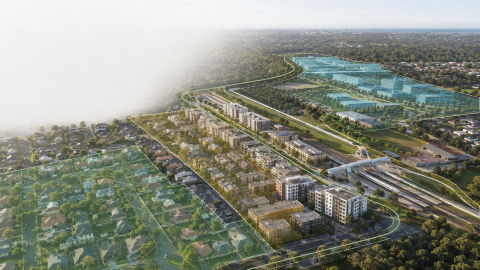
Australia’s housing crisis isn’t just about supply. It’s a planning problem
July 1st, 2026 Australia’s housing crisis is not just about building more homes. Explore how zoning, approvals, infrastructure timing and… Read More
What’s the difference between urban planning and urban design?
September 23rd, 2024 The terms are used interchangeably, but they aren’t the same. What’s the difference between urban design and urban planning… Read More
Urban planning for sustainability and social justice
November 6th, 2023 Australia’s sustainable urban planning has continued to become more prevalent. Discover what Australia has done well, as… Read More
Seven careers in property development
February 7th, 2023 Property development is a diverse and rewarding industry where you'll find more than just a role as a property development… Read More
How to become an urban planner
February 2nd, 2023 As our nation grows, the need for qualified urban planners will only increase. In fact, private and public sector employers… Read More