Technology manager salary in Australia: What can you earn?

Technology managers don't just keep the lights on. They connect infrastructure to strategy, translate technical risk into business language, and decide where the next dollar of technology investment should go. That's a different job depending on where you sit and a very different salary.
The trouble is, titles blur the picture. An "IT Manager" at a 50-person business and a "Technology Director" at a national bank can carry wildly different scope, budget and headcount. Salary benchmarks that lump these roles together tell you very little about what you could actually expect to earn.
This guide breaks down technology management salaries by career stage, compares related titles, and unpacks the factors, experience, industry, location, specialisation and commercial capability that separate a solid technology manager from one commanding a premium. It also looks at how postgraduate study fits into that progression.
Technology manager salaries in Australia vary significantly by title, seniority, industry and location. A single average figure doesn't tell the full story.
Career progression in technology management typically moves through four stages: early management, mid-career management, senior leadership and executive leadership.
Senior and executive roles (Head of Technology, CTO) often include bonuses, equity or incentives that make base salary comparisons alone misleading.
Specialisation in AI, cybersecurity, cloud or enterprise architecture is increasingly linked to higher-value roles, though it doesn't guarantee advancement on its own.
Strategic and commercial capability, the ability to connect technology decisions to business outcomes, is what typically separates mid-career managers from senior leaders.
What is the average technology manager salary in Australia?
There is no single reliable "average technology manager salary" in Australia. The figure depends heavily on title, seniority, industry and whether the benchmark reflects base salary or total remuneration.
| Role | Experience level | Location | Source | Data period | Remuneration basis | Salary range |
| IT Team Lead / IT Operations Manager | Early management (2–5 years) | Australia (national) | Hays Salary Guide | 2024–25 | Base salary | $100,000 – $130,000 |
| IT Manager | Mid-career (5–8 years) | Australia (national) | Hays Salary Guide | 2024–25 | Base salary | $120,000 – $150,000 |
| Technology Manager | Mid-career (5–10 years) | Australia (national) | Hays Salary Guide | 2024–25 | Base salary | $130,000 – $160,000 |
| Head of Technology | Senior leadership (10–15 years) | Australia (national) | Robert Half | 2024–25 | Base salary | $170,000 – $220,000 |
| Technology Director | Senior leadership (12+ years) | Australia (national) | Robert Half Salary Guide | 2024–25 | Base salary | $200,000 – $260,000 |
| Chief Technology Officer | Executive leadership (15+ years) | Australia (national) | Robert Half Salary Guide | 2024–25 | Total remuneration | $250,000 – $400,000+ |
Figures are indicative ranges drawn from published salary guides and job market data. Ranges reflect national averages and will vary by state, industry, organisational size and individual experience. Total remuneration for executive roles may include bonuses, equity and other incentives not captured in base salary figures alone.
Different platforms report different numbers because they survey different populations, weight locations differently, and define roles inconsistently. A SEEK listing average reflects advertised salaries; a Hays or Robert Half salary guide often draws on placement and client data; Jobs and Skills Australia data typically reflects broader occupational classifications rather than specific job titles. Read any single figure as one data point, not the full market.
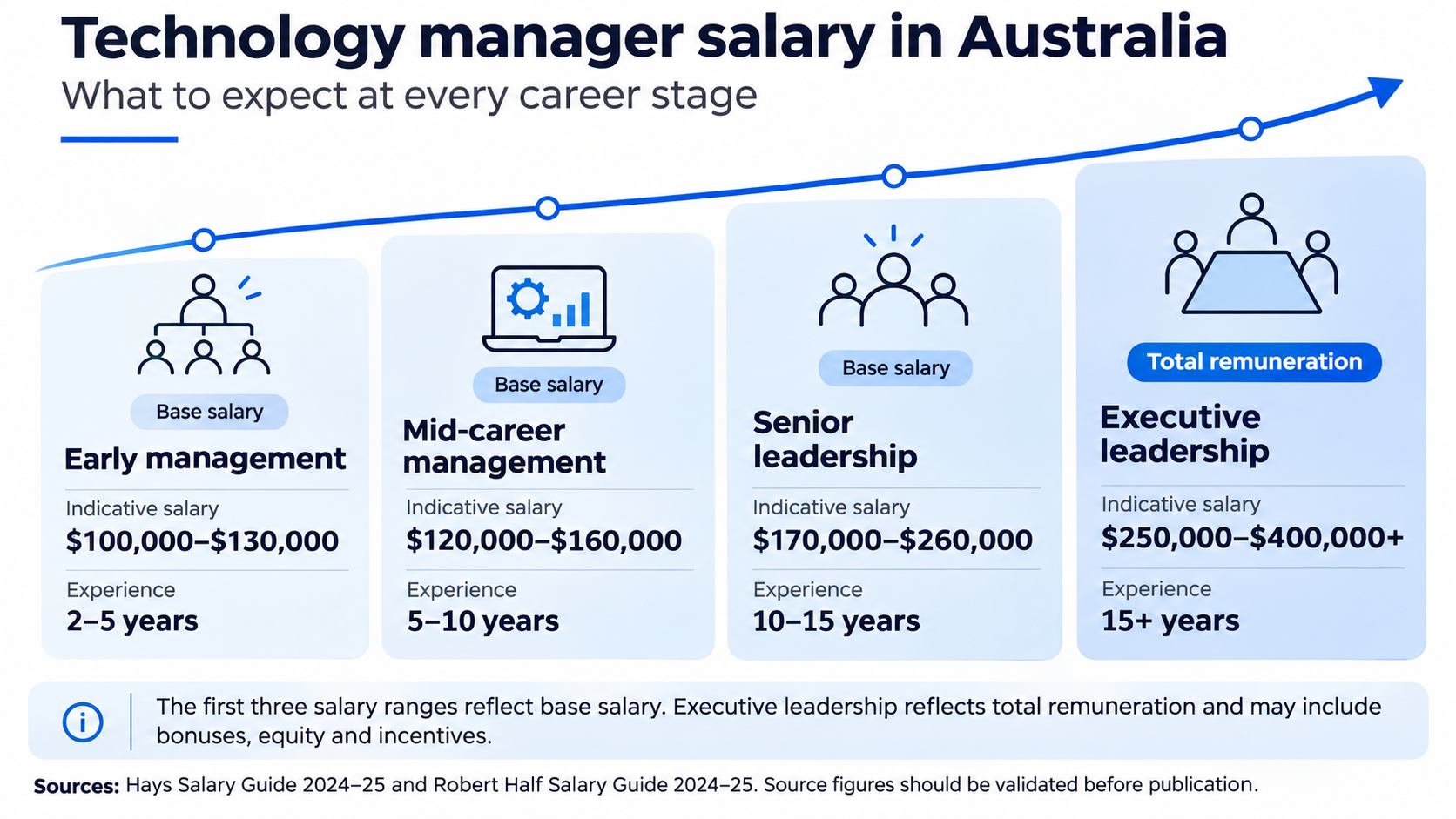
Technology manager salary by career stage
Salary in technology management tracks scope of responsibility more closely than years in the workforce alone. Here's how that typically plays out.
Early management: stepping into technology leadership
This stage covers roles like IT Team Lead, IT Operations Manager and Technology Operations Manager, the first step from individual contributor into people and project leadership.
At this stage, responsibilities usually include:
- Leading a small team of technical staff
- Owning delivery of specific projects or systems
- Balancing hands-on technical work with early management duties
- Reporting into a more senior manager or director
Salary range: $100,000–$130,000 base salary (Hays Salary Guide 2024–25, typical Australian salary range)
Mid-career: managing technology teams and strategy
Established Technology Managers, IT Managers and Digital Delivery Managers sit in this bracket. The shift here is from managing delivery to managing investment decisions.
Typical responsibilities include:
- Owning a budget and justifying technology spend to the business
- Managing vendor relationships and contracts
- Coordinating across departments rather than just within IT
- Balancing operational risk against innovation priorities
This is often where remuneration starts to diverge based on organisational influence rather than technical skill alone. A manager who sits in budget and strategy conversations typically commands more than one managing delivery in isolation.
Salary range: $135,000–$170,000 base salary (Robert Half Australia, 2026 Salary Guide, national IT Manager salary range)
Senior leadership: leading enterprise technology

Heads of Technology, Directors of Technology Strategy and Directors of Digital Transformation operate at enterprise scale. Their decisions shape multi-year roadmaps, not single projects.
At this level, expect:
- Accountability for large, often multi-million-dollar technology budgets
- Leadership of multiple teams or departments
- Governance of enterprise risk, compliance and architecture
- Direct influence on business strategy, not just technology delivery
Salary range: $170,000 – $220,000 base salary (Robert Half Salary Guide 2024–25, Australia national average)
Executive leadership: CTO and senior technology executives
Chief Technology Officers and comparable executives sit at the intersection of technology and company direction. Base salary is only part of the picture. Bonuses, equity, long-term incentives and other benefits frequently make up a significant portion of total remuneration, which makes simple base-to-base comparisons misleading.
Salary range: $250,000 – $400,000+ total remuneration (Robert Half Salary Guide 2024–25, Australia national average; includes base salary, bonuses, equity and other incentives)
Salary comparison across career stages
| Career stage | Experience level | Example titles | Indicative salary range | Remuneration basis | Source |
| Early management | 2–5 years | IT Team Lead, IT Operations Manager, Technology Operations Manager | $100,000 – $130,000 | Base salary | Hays Salary Guide, 2024–25, Australia national average |
| Mid-career | 5–10 years | IT Manager, Technology Manager, Digital Delivery Manager | $120,000 – $160,000 | Base salary | Hays Salary Guide, 2024–25, Australia national average |
| Senior leadership | 10–15 years | Head of Technology, Director of Digital Transformation, Technology Director | $170,000 – $260,000 | Base salary | Robert Half Salary Guide, 2024–25, Australia national average |
| Executive leadership | 15+ years | Chief Technology Officer (CTO), Chief Information Officer (CIO) | $250,000 – $400,000+ | Total remuneration (base salary, bonuses, equity and other incentives) | Robert Half Salary Guide, 2024–25, Australia national average |
Which technology management roles pay the most?
Rather than ranking roles purely by salary, it's more useful to understand what differentiates their scope, because that scope is what drives remuneration in the first place.
- IT Manager: Oversees day-to-day technology operations, infrastructure and support for a business unit or organisation.
- Technology Manager: Broader remit than an IT Manager, often spanning delivery, strategy input and cross-functional coordination.
- Head of Technology: Enterprise-level accountability for technology strategy, architecture and major programs.
- Digital Transformation Director: Leads large-scale change programs that reshape how an organisation uses technology.
- Technology Strategy Director: Focused on long-term technology roadmaps aligned to business direction.
- Chief Technology Officer: Executive accountability for the organisation's entire technology function, often reporting directly to the CEO or board.
The highest-paying roles tend to combine three things: enterprise-wide scope, direct influence on business strategy, and accountability for financial outcomes, not technical skill in isolation.
What factors influence a technology manager's salary?

Professional experience and leadership responsibilities
Years of experience matter less than what they've been spent doing. A manager who has delivered measurable outcomes, cost savings, successful transformations, team growth, typically commands more than one with equivalent tenure but narrower exposure.
Industry and organisational size
Technology management salaries can vary across financial services, consulting, government, healthcare, technology-native businesses and large enterprises. Regulated industries like finance often carry higher compliance and governance demands, which can shape both scope and remuneration.
Location and employment market
Sydney and Melbourne typically host the largest concentration of senior technology leadership roles. According to the Hays Salary Guide 2024–25, Sydney-based Technology Managers can expect base salaries toward the upper end of the national range, often $5,000–$15,000 above the national average, reflecting higher living costs and demand concentration. Melbourne sits comparably, while Brisbane, Perth and other capital cities generally track slightly lower for equivalent roles, though government and healthcare technology sectors in those markets are expanding their own senior leadership pipelines.
Technical expertise and specialisation
Specialising in AI, cybersecurity, cloud architecture, data governance or enterprise architecture can position a technology manager for higher-value roles, as these are capability areas organisations are actively investing in. However, the greatest value comes from combining technical expertise with the ability to apply it strategically to achieve business outcomes.
Strategic and commercial capability
The technology managers who progress fastest are usually the ones who can connect a technical decision to a business outcome, explaining not just what a system does, but what it's worth. This commercial fluency is increasingly what separates mid-career managers from senior leaders.
What skills do employers look for in technology managers?
Entry into management typically requires:
- Solid technical grounding in relevant systems or platforms
- Project management and delivery experience
- Basic team leadership and communication skills
- An understanding of how technology decisions affect the wider business
Progression into senior and executive roles adds:
- Digital strategy and innovation management
- Stakeholder management across the C-suite and board
- Commercial decision-making and budget ownership
- Technology governance and risk management
- Enterprise agility, the ability to adapt technology strategy as business conditions shift
- People leadership at scale, across multiple teams or departments
As AI reshapes technology management, strategic thinking, ethical judgement and people leadership are becoming increasingly valuable. These human capabilities also play an important role in careers that are less susceptible to AI-driven automation, particularly where complex decisions and professional accountability remain essential.
How can you progress from technology specialist to technology manager?
For professionals working in development, engineering, cybersecurity, infrastructure, data or IT operations, the path usually looks like this:
- Strengthen technical and industry experience. Depth in your specialisation builds the credibility leadership roles require.
- Build project and stakeholder management capability. Start owning delivery, not just execution.
- Take responsibility for team or technology initiatives. Lead something end-to-end, even on a small scale.
- Develop broader strategic and commercial understanding. Learn how your organisation makes investment decisions, not just how your systems work.
- Explore management opportunities and further professional development. Formal study can help consolidate and accelerate this shift.
Can postgraduate study support a career in technology management?
Postgraduate study can help professionals connect existing technical expertise with the strategic, leadership and innovation skills that enterprise technology roles demand but it works alongside experience, not instead of it.
The UTS Online Master of Technology Management is designed for analysts or managers with a technical background and business acumen, built around subjects including Digital Strategy: Aligning Business and Technology, Technology and Innovation Management, Building Enterprise Agility, Cybersecurity Management and Artificial Intelligence for Enterprises. Career outcomes associated with the course include General Manager IT Technology Operations, Group Head of IT Operations and Infrastructure, CTO and CIO.
For experienced professionals further along the career ladder, the Executive Master of Technology Management offers an accelerated pathway. Applicants with a relevant technology qualification and at least five years of professional experience may be eligible for recognition of prior learning covering 24 credit points allowing completion in as little as 16 months. This course is designed for professionals heading toward C-suite technology roles, with outcomes such as Group Head of IT and Operations and Global Head of IT and Operations.
It's worth being clear-eyed here: a postgraduate qualification can sharpen your strategic thinking and open doors, but career progression and salary growth also depend on how you apply those skills. What moves the needle is turning that capability into real outcomes.
Is technology management a good career in Australia?
Technology management sits at the centre of how organisations adopt AI, manage cybersecurity risk, and run large-scale digital transformation all areas under active investment across Australian industry. That creates genuine opportunity for professionals who can combine technical credibility with strategic and commercial thinking.
It also comes with real challenges: accountability for complex risk, pressure to deliver measurable business value, and a market that's constantly resetting expectations around emerging technology like AI. According to Jobs and Skills Australia's Internet Vacancy Index, advertised demand for ICT managers has remained persistently strong, with technology leadership roles among the harder-to-fill positions across the economy. For professionals who want to lead rather than only execute, it remains one of the more dynamic paths in the modern workplace.
Explore technology leadership pathways with UTS Online

Technology management isn't a single destination, it's a career that keeps evolving, from first-time team leadership through to the executive table. Wherever you sit on that path, developing the strategic, commercial and leadership capability to match your technical expertise is what moves you forward.
UTS Online's Master of Technology Management and Executive Master of Technology Management are built for professionals doing exactly that, strengthening the skills that connect technology to business impact, while staying in employment. Explore how UTS Online's technology management courses can help you strengthen your strategic and leadership capability.
Related courses: Master of Technology Management · Executive Master of Technology Management · Graduate Certificate in Technology Management · Graduate Certificate in Artificial Intelligence Management
Frequently asked questions
Technology Manager salaries range from $100,000 – $130,000 at the early management stage up to $250,000 – $400,000+ total remuneration at the executive level, based on the Hays Salary Guide and Robert Half Salary Guide (2024–25). Figures vary by title, industry, location and organisational scope. See the salary tables above for a full breakdown by career stage.
Not necessarily. The two titles often overlap in scope, and which pays more depends on the specific organisation's structure, the size of the team managed, and the level of strategic responsibility attached to the role, rather than the title alone.
Executive roles such as Chief Technology Officer typically carry the highest total remuneration. Based on the Robert Half Salary Guide 2024–25, CTOs and comparable executives earn $250,000 – $400,000+ in total remuneration, including base salary, bonuses, equity and other incentives. See the career-stage comparison table above for a full breakdown.
Most Technology Managers progress from technical specialist roles by building project and stakeholder management experience, taking on team or initiative leadership, and developing broader strategic and commercial understanding, often supported by postgraduate study.
A technical background is common and often expected, particularly in senior roles, but it's typically paired with leadership, strategic and commercial skills rather than relied on alone.
A relevant Master's degree, such as the UTS Online Master of Technology Management or Executive Master of Technology Management, can strengthen the strategic and leadership capabilities needed for career progression. Combined with relevant experience and the ability to apply new skills in practice, postgraduate study can help position you for greater responsibility and broader career opportunities.